Key Points
- Rubio demanded Iran's U.N. delegation leave the U.S. immediately after talks stalled, a U.S. official said.
- Foreign Minister Abbas Araghchi was among those ordered out; the delegation flew to Doha early Tuesday.
- The expulsion order exposes how far U.S.-Iran contacts have broken down as Qatar keeps mediating.
The latest:
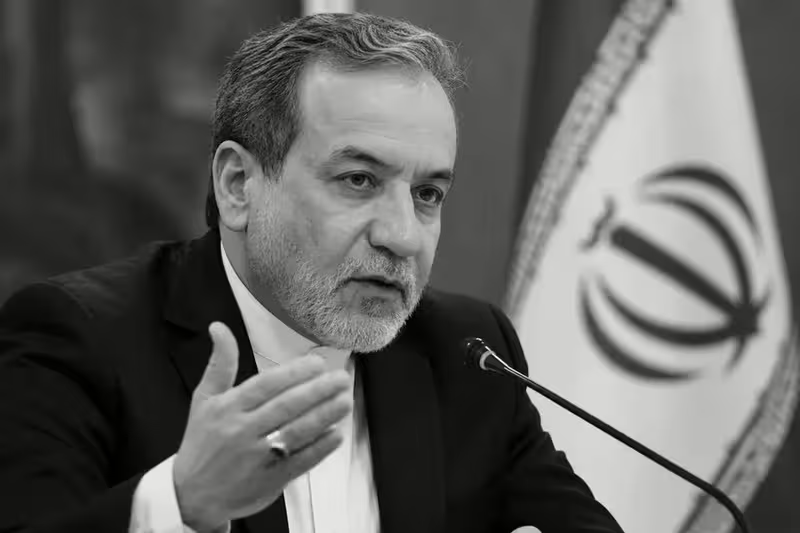
Iran’s delegation to the U.N. General Assembly was ordered to leave the United States immediately on Monday evening after negotiations hit a stalemate, a U.S. official and a second source with knowledge of the matter told Axios. Secretary of State Marco Rubio gave the order. Those told to go included Foreign Minister Abbas Araghchi, Rubio’s direct counterpart.
Details:
- The order: On Monday evening, at Rubio’s instruction, the U.S. mission to the United Nations informed the Iranian mission that Araghchi’s delegation had to leave New York immediately, according to the U.S. official. The step is a sharply unusual rebuke between two governments that maintain no formal relations.
- The timeline: The White House believed on Monday morning that talks with Iran might advance later in the day, the U.S. official said. By late afternoon the negotiations were deadlocked. The delegation left for the airport several hours after the order and boarded a flight from New York to Doha at 1:20 a.m. Tuesday.
- The U.S. framing: The American official cast the move as a matter of expired welcome rather than a rupture, saying the General Assembly had ended and it was time for the Iranians to go. The official said Rubio “kicked out the Iranian delegation who had overstayed their welcome.”
- The caveat: A second source confirmed the United States demanded the delegation’s departure, but said Araghchi had been scheduled to fly back to Tehran on Monday night in any case. On that account the practical effect of the order was limited, even if its diplomatic signal was not.
- The mediation: Qatari mediators tried to engineer a breakthrough between Washington and Tehran during the assembly but made little progress, with neither side willing to move from its position, according to Axios. Regional sources said the Qataris are still talking to both parties about a compromise proposal.
- Trump’s language: President Trump, asked Wednesday how he could reach an agreement with a government he describes as crazy, told reporters he might blow them up, said the administration has to make that decision, and predicted the matter would end very soon one way or the other, according to Axios.
- The stakes: The diplomatic track has been running alongside efforts to broker an end to the war, which have so far produced no result. The order came at the moment the Qatari channel stalled rather than at the start of the assembly, tying it directly to the breakdown in talks.
- What’s unstated: The U.S. official did not describe the substance of the compromise proposal, name the sticking points behind the stalemate, or say whether further U.S.-Iran contact is scheduled. Iran has not publicly addressed the departure order.
Background:
Washington and Tehran have no diplomatic relations, and Iranian officials travel to the United States only for United Nations business under visa arrangements tied to the U.N. headquarters agreement. That makes the General Assembly one of the few settings where direct or near-direct contact becomes possible.
Between the lines:
Two accounts of the same night sit side by side: an order to leave immediately, and a flight Araghchi was already booked on. Both can be true, and the gap between them is the point — the order’s value was in being issued and known, not in moving anyone. That the White House expected progress that morning and issued the order that evening suggests the rebuke was calibrated to the collapse of the Qatari effort.
What’s next
Watch whether Qatari mediators report movement on their compromise proposal, whether Tehran responds publicly to the expulsion, and whether Trump’s stated choice between a deal and military action produces a decision point.