Key Points
- OpenAI appointed Motti Hadas as its first Israel-focused commercial executive, replacing remote market coverage with direct engagement.
- Israel offers globally oriented startups, while OpenAI’s Gulf strategy centers on infrastructure and government-scale deployment.
- The move intensifies enterprise competition and links two complementary centers of the region’s expanding AI economy.
The latest
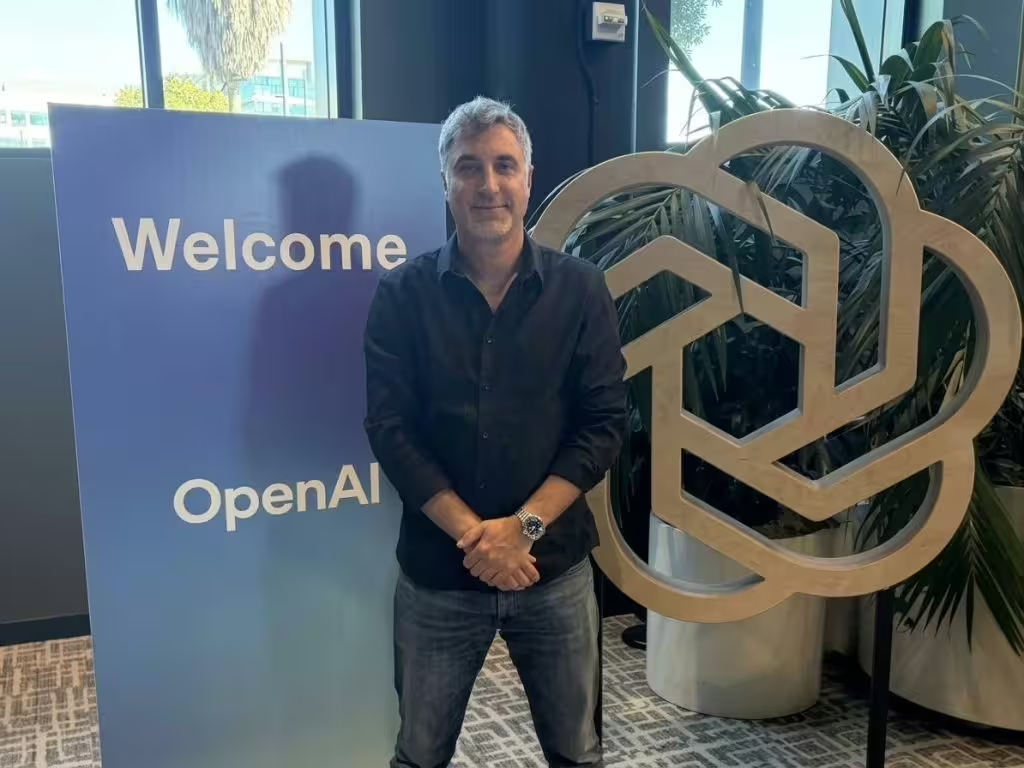
OpenAI is building a direct commercial presence in Israel through Motti Hadas, its first go-to-market executive dedicated to the country. The former Matrix vice president and senior commercial executive at Google and MongoDB will develop sales and services, cultivate relationships with startups and enterprises, and help Israeli companies integrate OpenAI models into products and business operations. The appointment marks a shift from serving Israel remotely through OpenAI’s wider Europe, Middle East and Africa organization.
Details
- Commercial first: The initial operation will focus on sales, services and partnerships rather than opening a research and development center. Hadas described his role on LinkedIn as bringing OpenAI technologies to Israel’s “Digital Native” community and helping local companies build AI-driven products.
- Changed approach: Two months earlier, sources close to OpenAI told Globes that the company had no plans to appoint a dedicated Israeli manager or establish a local office. Hadas’s appointment gives OpenAI a direct channel into the market, although his listed base is Israel and his operating location remains unclear.
- Startup access: Israel’s technology ecosystem includes companies specializing in cybersecurity, enterprise software, fintech, healthcare technology, defense applications and data infrastructure. Many pursue international customers from their earliest stages, allowing OpenAI to engage with products and technical teams before those businesses expand globally.
- Enterprise rivalry: OpenAI is competing with Anthropic, Google and Microsoft as the industry moves beyond general-purpose chatbots toward coding tools, autonomous agents and deeper corporate integration. Reuters reported that OpenAI’s annualized recurring revenue is approaching $70 billion, with enterprise sales doubling since July.
- Gulf infrastructure: OpenAI’s regional strategy also includes Stargate UAE, announced in 2025 as the infrastructure platform’s first international deployment. The planned one-gigawatt Abu Dhabi cluster involves G42, Oracle, Nvidia, Cisco and SoftBank, with applications spanning government, healthcare, energy, education and transportation. The UAE was also announced as the first country where ChatGPT would be enabled nationwide.
- Regional consequences: Israel contributes startups, engineers and specialized applications, while the UAE provides capital, computing infrastructure and government-scale deployment. This combination could create opportunities for Israeli developers to access Gulf resources and for Gulf businesses to use Israeli-developed applications, depending on commercial, regulatory and political conditions.
Background
The Israel Innovation Authority has identified the absence of frontier AI companies such as OpenAI and Anthropic as a strategic gap. It argues that even small local teams could deliver disproportionate value through access to advanced technology, talent, international networks and entrepreneurial spillovers.
What’s next
The next dated milestone is in 2026, when 200 megawatts of Stargate UAE’s planned capacity are expected online. In Israel, Hadas’s commercial activity will indicate whether OpenAI broadens its presence beyond sales and partnerships into engineering or research.