Key Points
- Microsoft, the UAE Cyber Security Council and Core42 will deploy MDASH across government entities.
- Core42's Sovereign Public Cloud will host onboarding and implementation, with Microsoft as partner.
- The deal places AI code security inside UAE government systems rather than bolted on afterward.
The latest:
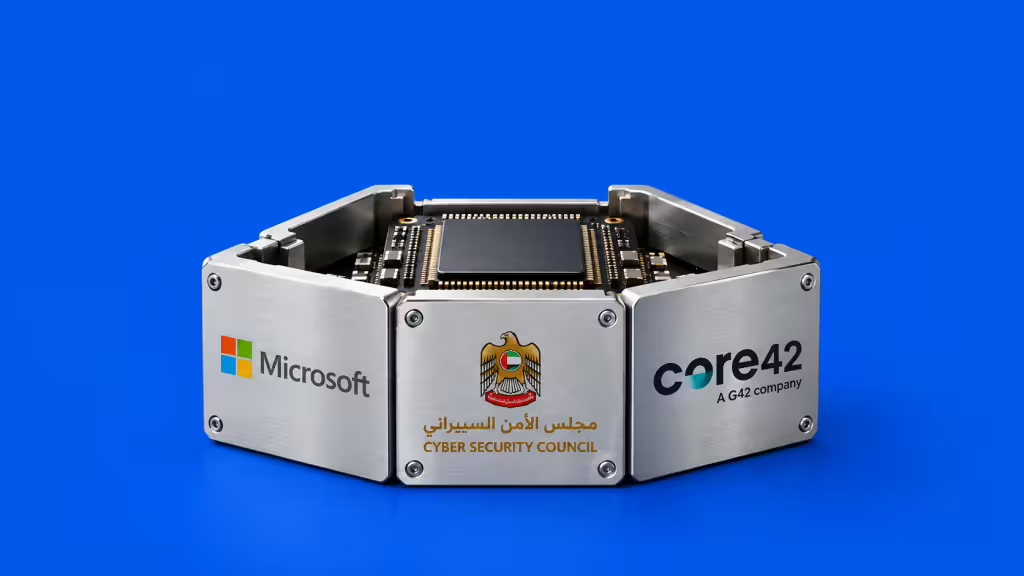
AI-powered cybersecurity is heading into UAE government systems under a collaboration announced by Microsoft, the UAE Cyber Security Council and Core42, a G42 company. The three parties said they plan to deploy MDASH, Microsoft’s AI security capability, across government entities to speed up threat response. Rollout will be phased, starting with awareness sessions, pilots and technical workshops.
Details:
- The technology: MDASH is described by Microsoft as an AI-powered cybersecurity capability that uses advanced AI models and automated analysis to identify vulnerabilities, prioritize risks and improve security posture at speed and scale. It is the core asset being pushed into UAE government environments under the collaboration.
- The sovereign layer: Core42 will deliver the deployment through its Sovereign Public Cloud offering, built in partnership with Microsoft, and will handle onboarding, implementation and capacity-building. Core42 said the focus is on security, privacy and operational resilience, keeping operational control with government entities rather than offshore.
- The regulator’s role: The Cyber Security Council will support government adoption and responsible use of AI for cybersecurity through the UAE’s National AI Test and Validation Lab. That positions a state validation body between the vendor technology and the government systems that will run it.
- The UAE position: Mohamed Al Kuwaiti, Head of Cyber Security for the UAE Government, said code safety is a national priority and a cornerstone of cyber resilience, arguing that as AI becomes integral to government and critical services, securing the underlying code must be built in from the outset rather than treated as an afterthought.
- Microsoft’s framing: Hayete Gallot, Executive Vice President for Security and Emerging Technologies at Microsoft, said governments worldwide increasingly see AI as a force multiplier to protect national assets and people. She said the three parties will help government organizations strengthen resilience and build capacity for emerging threats.
- Core42’s pitch: Chief Executive Talal M. Al Kaissi said the UAE made a deliberate choice to lead in AI adoption, and that leadership carries responsibility for secure digital infrastructure. He said Core42 and the wider G42 ecosystem are positioned to extend the partnership’s benefits to customers.
- The rollout plan: The parties plan a phased deployment beginning with awareness sessions, pilots, technical workshops and onboarding for government entities. No completion date, target number of participating entities or financial terms were disclosed in the announcement.
- Stated objectives: The collaboration aims to strengthen national cyber resilience, accelerate secure digital transformation and help government security teams respond faster to evolving threats. The parties said it will also help protect critical services and prepare organizations for the next generation of cyber attacks.
Background:
Core42 is a G42 company and one of the UAE’s main sovereign cloud and AI infrastructure operators. The Cyber Security Council is the federal body responsible for national cyber policy, and it runs the National AI Test and Validation Lab cited in this collaboration.
Between the lines:
The structure matters as much as the technology. By routing a Microsoft capability through Core42’s sovereign cloud and the Cyber Security Council’s validation lab, the UAE gets frontier AI security tooling while keeping the hosting layer and the approval gate domestic. Al Kaissi’s emphasis on operational control, and Al Kuwaiti’s on building security into code from the outset, both point the same way: adoption on sovereign terms.
What’s next
Watch the first pilot results and technical workshops with government entities, and whether the parties later disclose how many entities join the phased rollout or when MDASH moves from pilot to full deployment.