Key Points
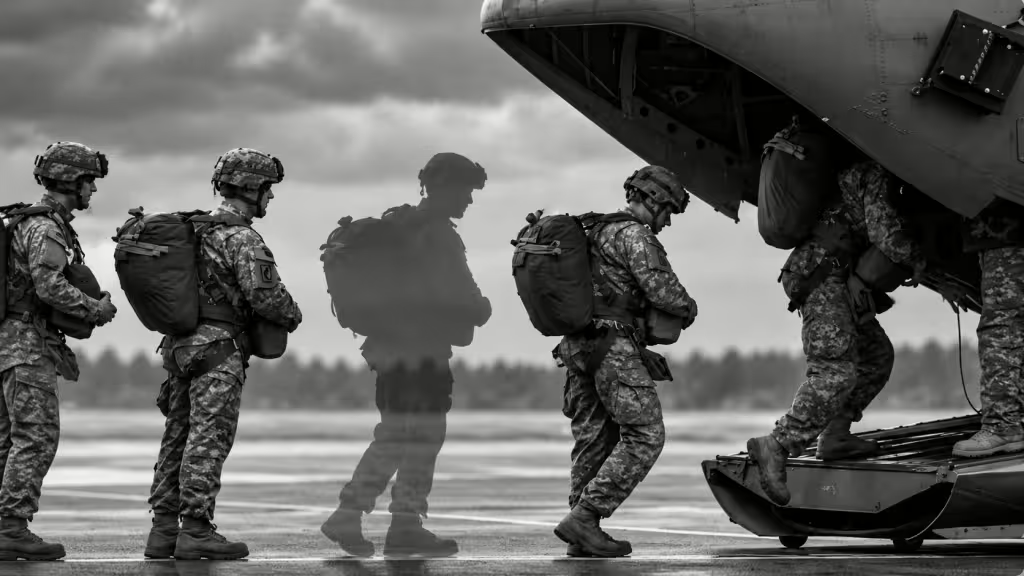
- Washington shut its last major Iraqi base Wednesday, ending a 23-year deployment costing $1.7 trillion.
- Prime Minister Ali al-Zaidi's September 30 deadline for Iran-backed militias to disarm has largely gone unmet.
- Iran-backed groups hold ministries and parliament seats, leaving Baghdad militarily outmatched as American cover ends.
The latest:
The last major American military base in Iraq closed Wednesday, ending a presence that spanned more than 23 years and $1.7 trillion, according to The Wall Street Journal. The same date was Prime Minister Ali al-Zaidi’s deadline for Iran-backed militias to surrender their weapons. Zaidi and his deputies are now discussing pushing that deadline into next year.
Details:
- The drawdown: A US defense official said equipment and personnel were airlifted out of Erbil, the last American base, in time for Wednesday’s deadline. Current and former US officials said a Patriot battery stationed around Erbil has already been removed, and remaining air defenses will likely concentrate on the Baghdad embassy and Erbil consulate.
- What stays behind: Some US Marines will remain to protect diplomatic missions, alongside contractors maintaining Iraq’s F-16 fleet and American-made tanks, current and former US officials said. A Pentagon official said Washington is ending its official military operation but retains intelligence, surveillance and other regional capabilities that could be used in Iraq.
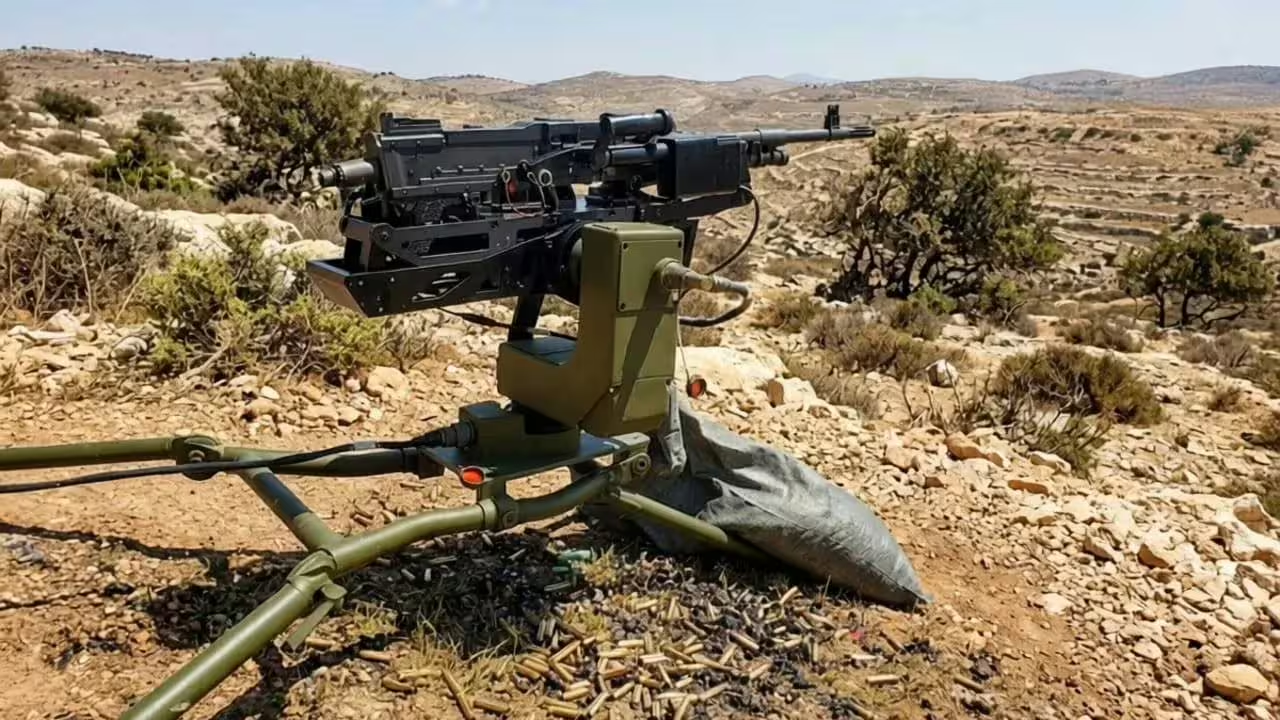
- The attack tempo: Militants and Iranian forces launched more than 600 attacks on US diplomatic and military facilities in Iraq during the war’s first two months, the Journal reported. Recent strikes used longer-range missiles and drones, a US official said, indicating an upgrade. Attacks damaged a US diplomatic and logistics hub at Baghdad airport.
- Iranian resupply: Current and former US officials and defense experts said Tehran renewed support for Iraqi militias after the US bombing campaign in Iran began in February. A US official said the flow of small arms, drones and short-range rockets slowed while Tehran fought the US, then ramped up this summer.
- Regional spillover: Saudi Arabia said a drone attack launched this month from Iraq near the Iranian border temporarily closed its East-West oil pipeline, a route that gained importance after Iran disrupted shipping in the Strait of Hormuz.
- The refusal: Kazem al-Fartousi, spokesman for Kata’ib Sayyid al-Shuhada, a US-designated terrorist group, said forced disarmament “will not happen.” He said his faction and other militias hold senior ministry posts and dozens of parliament seats, and helped produce the government through post-election negotiations.
- Partial compliance: Maj. Gen. Saad Maan, an Iraqi military spokesman, said some factions had handed in weapons and others plan to. Asaib Ahl al-Haq, another US-designated group, said it would work with the government. David Schenker, a former assistant secretary of state, assessed that such groups want sanctions relief.
- The balance of force: Iraq’s Counter-Terrorism Service, the US-trained unit that fought ISIS, commanded roughly 14,000 soldiers as of 2024, fewer than the militias, whose members number in the tens of thousands. The army collapsed against ISIS in 2014. Victoria Taylor, a former senior State Department official, called disarmament within months impossible.
- The kidnapping risk: The US Embassy in Baghdad now issues about two security warnings a week concerning kidnapping. American freelance journalist Shelly Kittleson was seized in Baghdad in late March by militiamen believed tied to Kataib Hezbollah and released about a week later after negotiations with the government, US officials said.
- The premier: Zaidi, 41, a businessman who had never held public office before becoming prime minister in May, owns a bank, an insurance company and media and construction firms. The Treasury barred his bank from dollar transactions in 2024 over suspected financing of Iran and its proxies; Zaidi denied knowledge of such transactions.
Background:
The withdrawal follows a Biden-era agreement with the previous Iraqi prime minister to remove American troops by 2026. The US invaded in 2003 over Bush administration claims of weapons of mass destruction, later proven false. Close to 4,500 American troops and as many as 300,000 Iraqis were killed.
Between the lines:
Taylor assessed that the militias exist because Iran finds continued utility in them as leverage against Baghdad and Washington, and that this will persist after the troops leave. The structural facts support her: groups that reject disarmament sit inside the ministries and parliament that selected Zaidi, while the state force meant to confront them is smaller than they are. A deadline pushed to next year changes the calendar, not the balance.
What’s next
Watch whether Zaidi formally extends the disarmament deadline, whether more factions follow Asaib Ahl al-Haq in cooperating, and whether attacks on the Baghdad embassy and Erbil consulate continue after the base closure.