Key Points
- Smart Shooter secured a three-year US government anti-drone contract with a ceiling of $150 million.
- The sole-source framework covers SMASH fire-control systems, training and support for military and federal counter-drone missions.
- The award expands a US business already driving more than half of the company’s first-half 2026 orders.
The latest
Israeli defense technology company Smart Shooter has won an indefinite-delivery, indefinite-quantity US government agreement worth up to $150 million over 36 months, making it the exclusive provider of SMASH systems and related services under the counter-drone framework. The ceiling reflects the maximum value of potential orders rather than a guaranteed purchase, while individual orders will set quantities, configurations and delivery schedules for US forces.
Details
- Contract authority: Awarded by Joint Interagency Task Force 401 and announced by the US Department of War on September 29, the agreement supports the Domestic Shield program. The task force coordinates counter-drone work across military and federal agencies, with the program focused on threats inside the United States and related missions overseas.
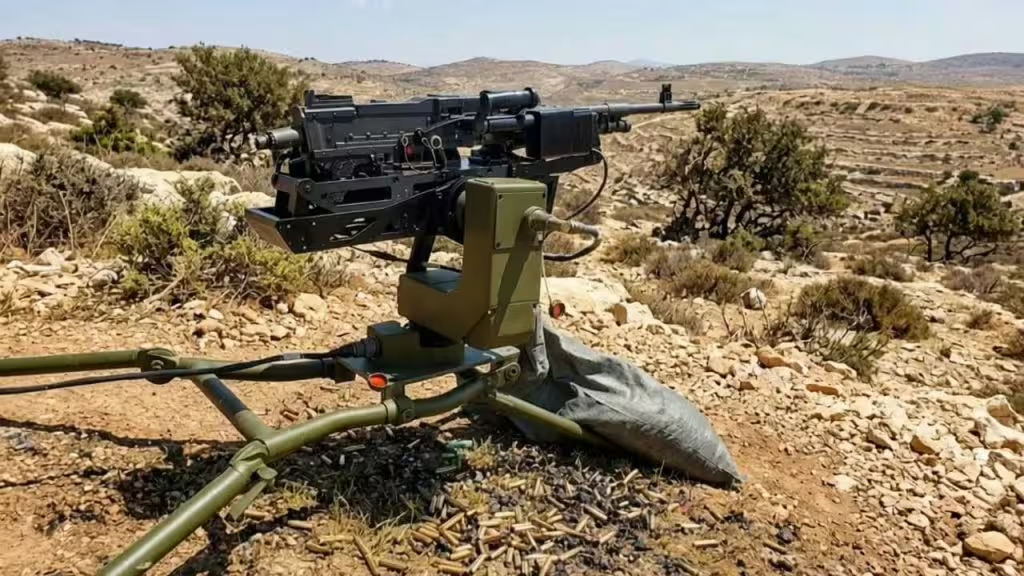
- Rifle-mounted response: SMASH is designed to let soldiers engage small aerial targets with standard firearms rather than relying exclusively on missiles or dedicated interceptors. It combines artificial intelligence, computer vision and tracking algorithms to follow a target, calculate a firing solution and synchronize firing when the weapon is aligned.
- Human decision: The system does not independently decide whether to attack. The soldier retains responsibility for engagement, while SMASH can connect with external sensors and battlefield-management systems, placing the weapon within a wider network for detecting, tracking and countering drones.
- Cost pressure: A relatively inexpensive drone can threaten personnel or equipment worth millions of dollars, making missile-only interception economically inefficient even when operationally effective. That imbalance is increasing demand for electronic warfare, directed-energy weapons, interception drones and AI-assisted firearms that can respond at different ranges and costs.
- US order book: The framework follows 2026 awards of $10.7 million from the US Army, $3.4 million from the Marine Corps and $1.8 million from the Navy. Smart Shooter reported about $43 million in firm first-half orders, 55% from US customers, and a $51.6 million backlog at the second quarter’s end.
- Company footprint: Thousands of its systems are already deployed across the US armed forces, Smart Shooter said. Founded in 2011 by former Rafael executives Michal Mor and Avshalom Ehrlich, the company is based at Kibbutz Yagur in northern Israel and also develops fire-control technology for robotic platforms.
Background
Small drones are increasingly accessible, inexpensive and difficult to detect or neutralize, and can support surveillance, targeting, attacks and disruption of critical infrastructure. Their spread has pushed armed forces toward layered defenses combining sensors, electronic warfare, directed energy, interception drones and lower-cost kinetic systems. Battlefield developments in Ukraine and the Middle East have accelerated demand for these capabilities.
What’s next
Orders issued during the agreement’s 36-month term will determine how much of the $150 million ceiling is used, alongside system quantities, delivery timetables, configurations, training and support requirements.