Key Points
- Six novels made the 2026 Booker Prize shortlist, announced Tuesday in London.
- Past winners Marlon James and Douglas Stuart are both nominated again this year.
- A win by either would be only the fifth double victory in Booker history.
The latest:
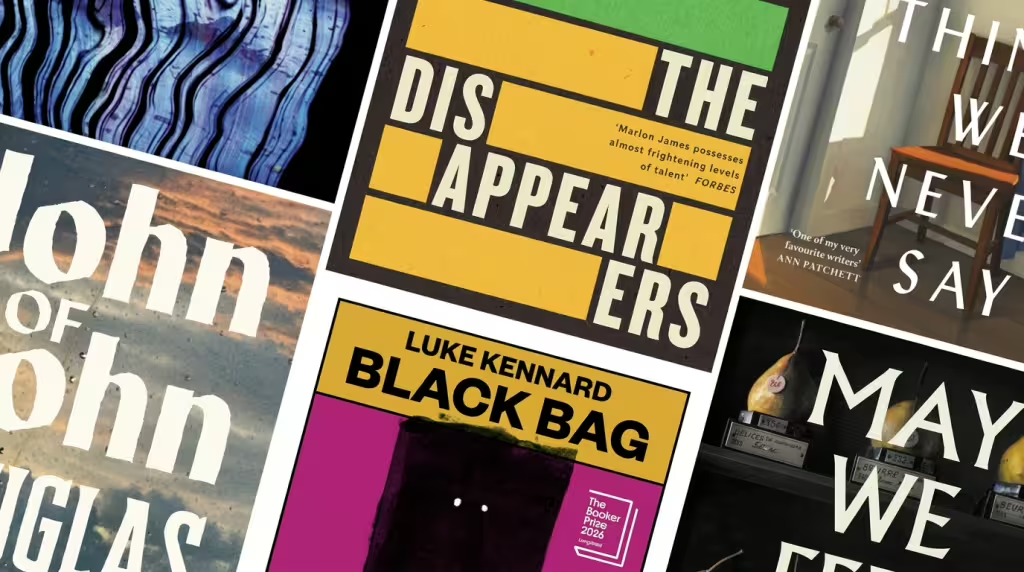
Two former Booker Prize winners are in contention again, after Marlon James’s “The Disappearers” and Douglas Stuart’s “John of John” made a six-book shortlist announced Tuesday. Judging panel chair Mary Beard said the titles were chosen after four hours of deliberation and share the capacity to make readers see the world differently. The winner will be named on Nov. 9 at a London event.
Details:
- The prize: The Booker, first awarded in 1969, goes each year to a novel written in English and published in Britain or Ireland. The winning author receives £50,000, about $66,700. The judges announce their decision on Nov. 9 at an event in London.
- The rare feat: James won in 2015 for A Brief History of Seven Killings and Stuart won in 2020 for his debut, Shuggie Bain. Should either take the prize again, it would be only the fifth time in the award’s history that a writer has won twice.
- James’s novel: The Disappearers is a 640-page book tracing the fallout from a deadly homophobic attack in Jamaica. Dwight Garner, reviewing it for The New York Times, called it the novel of the decade. James told The Times the unflinching depictions of sex and violence were deliberate.
- Stuart’s novel: John of John, Stuart’s third novel, follows Cal, a 22-year-old gay man returning to live with his angry father on a remote Scottish island. Mark Harris wrote in The Times that Stuart builds something stranger and far more original than a coming-of-age story.
- The oldest contender: M. John Harrison, 81, would become the oldest Booker winner if his 13th novel, The End of Everything, prevails. Set in a dystopian Britain, it follows a scavenger who finds an alien on a beach. Judges said it reads as thriller, mystery, satire, dystopia, road novel or realism.
- The campus satire: Luke Kennard’s Black Bag, inspired by a 1960s experiment at Oregon State University, features a professor who hires a failing actor to attend classes concealed inside a black bag. Johanna Thomas-Corr of The Times of London described a tender meditation on the difficulty of being a man today.
- The debut: Rebecca Perry’s May We Feed the King is the only first novel on the list. It grew out of two short stories, one about a woman recreating historical scenes with food, another about an attendant to a dying king, merged into a narrative swerving between past and present. A major British bookseller already gave it a best-debut award.
- Strout’s entry: Elizabeth Strout’s The Things We Never Say is set around the 2024 U.S. presidential election and follows a high school history teacher who considers suicide before a sailing accident and a buried family secret upend his life. Maggie Shipstead wrote in The New York Times that reading it was a pleasure despite occasionally clunky political references.
- The judging: Beard said in a telephone interview that literary reputations had not influenced the panel’s choices, despite the shortlist containing several of the year’s most acclaimed novels. She added that all six titles grab the reader, some with gentle tweaks and some more aggressively.
Between the lines:
Beard’s insistence that reputation played no part sits alongside a shortlist headed by two previous laureates and a critic’s declaration that James wrote the novel of the decade. The panel’s own framing, stressing genre range and the capacity to unsettle, points to criteria built around effect on the reader rather than career standing.
What’s next
The judges announce the winner on Nov. 9 in London. Watch whether James or Stuart converts a second nomination into a fifth-ever double win, or whether Harrison, at 81, becomes the oldest author to take the prize.