The latest:
At least 38,700 Toyota vehicles entered Yemen over four and a half years, including a surge last year led by Land Cruiser models, followed by a sharp drop this year after Gulf shipping lanes closed. The figures come from a Canadian armed forces veteran turned geopolitical security analyst, known as AJ Signal, who told The Times he tracks Toyota shipping manifests rather than missile inventories.
Details:
- The method: AJ Signal said his work rests on 10 years of open-source analysis of shipping patterns, delivery data and sales forecasts drawn from Toyota’s own investor page. He said the data exposes any deviation from historical sales patterns, which he treats as an early conflict signal.
- The Yemen numbers: He put arrivals at no fewer than 38,700 vehicles in four and a half years, with Land Cruisers leading last year’s spike. The decline this year followed the closure of Gulf maritime corridors, he said, without specifying which routes or operators were affected.
- The routes: The pickups were shipped by sea directly to Turkey, Jordan, Syria, Yemen and Gulf states, then moved overland across the Middle East, AJ Signal said. He added that Pakistan is now producing small Toyota pickups 17% above any previous period, and that he does not believe they are destined for local markets.
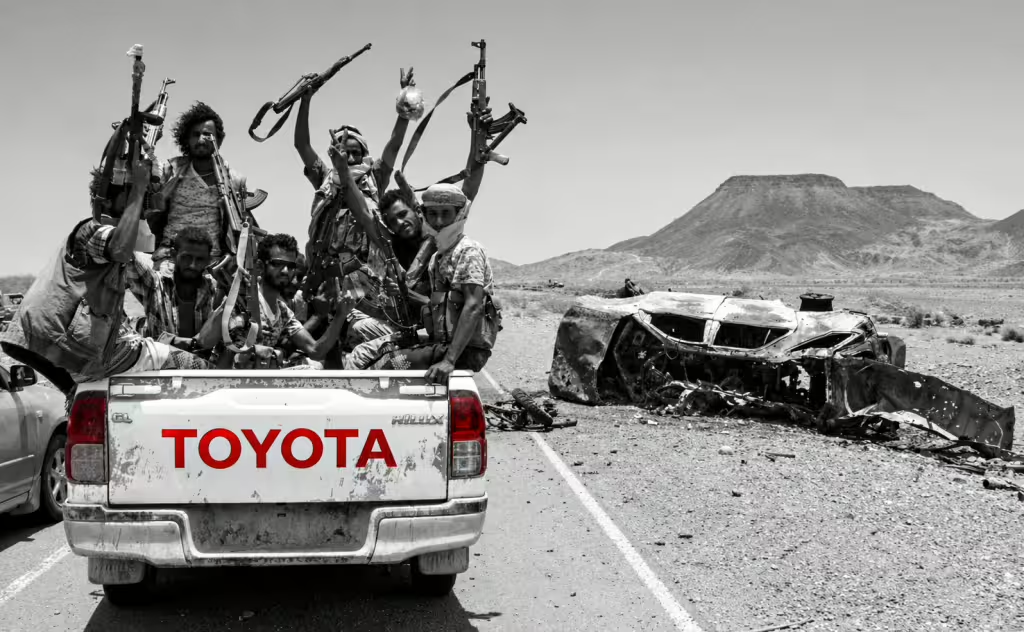
- The Houthi advance: Houthi fighters launched a lightning offensive last week and took control of the strategic Bab al-Mandab strait. Propaganda video released days later showed thousands of fighters clinging to Toyota beds in convoys crossing the desert along the Red Sea coast as gunmen prepared further operations.
- Why the Hilux: The appeal is mechanical, not ideological: a rugged frame, performance on unpaved tracks and sand dunes, and an open rear bed that takes heavy machine guns or rocket launchers. Unlike weapons, a Hilux or an F-150 needs no export licence to reach an insurgent buyer.
- The 1987 precedent: The final phase of the Chad–Libya war became known as the Toyota War after France supplied Chad with 400 Hilux and Land Cruiser pickups plus anti-tank and anti-aircraft missiles. Paired with French air support, they beat a Libyan force of 8,000 troops and 300 T-55 tanks.
- Battle of Fada: A Libyan armoured brigade was nearly wiped out, with 784 Libyan and Democratic Revolutionary Council fighters killed, 92 T-55 tanks and 33 BMP-1 vehicles destroyed, and 13 tanks and 18 BMP-1s captured. Chad lost 18 soldiers and three Toyotas.
- The Iraq spike: Toyota’s own figures showed Hilux and Land Cruiser sales in Iraq tripling from 6,000 in 2011 to 18,000 in 2013, before falling to 13,000 in 2014, according to ABC News. The jump preceded the Islamic State offensive that reached the outskirts of Baghdad.
- The company’s denial: Toyota has denied selling vehicles to insurgents, stating in 2015 that it has a strict policy against buyers who might use or modify them for paramilitary or terrorist purposes. In 2014 it said it could only assume the vehicles came through informal channels traded between individuals, which a manufacturer struggles to trace.
- The label: The armed pickups became known as technicals, a term that emerged in Somalia in the early 1990s when aid organisations paid local armed groups under the heading of technical assistance. Toyotas also made up two-thirds of the vehicles in Islamic State parades in Raqqa.
Background:
The Land Cruiser was originally designed as a military vehicle inspired by the Willys Jeep during the US occupation of Japan after World War II. Its battlefield reputation hardened in the 1980s, when the Chad–Libya conflict proved cheap civilian pickups could defeat Soviet-era armour.
Between the lines:
The supply chain is the vulnerability no export-control regime covers. A vehicle sold legally in an open market, resold privately and moved overland arrives without a licence trail, which is precisely why Toyota’s 2014 statement pointed to untraceable informal transfers. That leaves purchase data as one of the few signals available, and AJ Signal’s 17% Pakistani production figure is read against demand he attributes to buyers outside local markets.
What’s next
Watch whether Gulf shipping lanes reopen and Yemen-bound deliveries rebound, whether Houthi forces hold Bab al-Mandab, and whether Pakistani pickup output stays 17% above prior levels.