Key Points
- Iran’s supreme leader has made no public appearance since succeeding his father more than six months ago.
- Authorities cite security concerns after injuries sustained in the February 28 US-Israeli strike.
- His invisibility is intensifying scrutiny of decision-making and the Revolutionary Guards’ expanding public role.
The latest
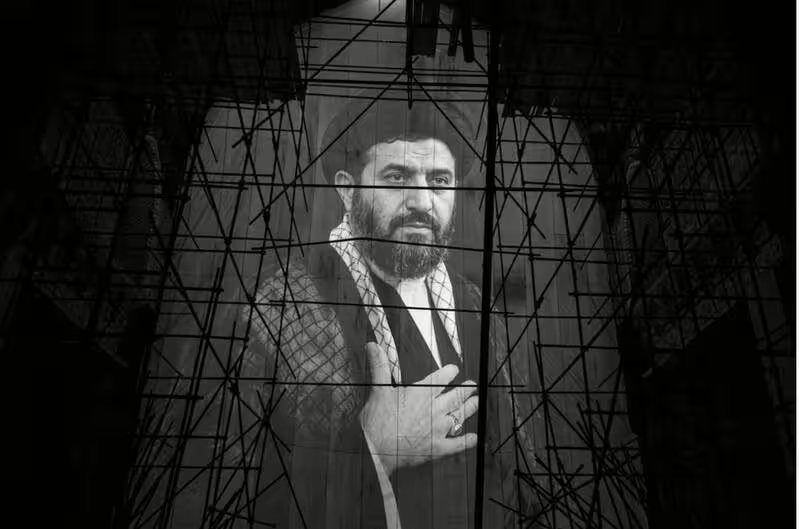
More than six months after becoming Iran’s supreme leader, Mojtaba Khamenei remains out of public view, issuing written statements but offering no recent photograph, video or audio address. The 56-year-old succeeded his father, Ali Khamenei, after the February 28 US-Israeli strike that killed the elder leader and several family members. Authorities say security concerns explain the secrecy and insist Mojtaba recovered from limited injuries, while his prolonged absence has fuelled questions over his health, governing authority and who is directing the Islamic Republic.
Details
- Contrasting visibility: Mojtaba’s low profile departs sharply from his predecessors. Ruhollah Khomeini regularly addressed Iranians after the 1979 Islamic Revolution, while Ali Khamenei frequently appeared on television and used speeches to define political and ideological direction. Before his succession, Mojtaba spent much of his career in religious circles and remained little known outside the political and clerical establishment.
- Funeral absence: His absence was especially conspicuous at Ali Khamenei’s funeral in July. The former leader’s other three sons appeared beside his coffin, while President Masoud Pezeshkian and senior military officials attended. Authorities said attendance at such a large gathering would have created an unacceptable assassination risk following the February strikes.
- Official health account: In May, an Iranian health official described Mojtaba’s wounds as superficial, affecting his face, head and legs, and said he left hospital shortly after the attack. Other officials have said he is in good health. Pezeshkian has repeatedly said communication with the supreme leader remains active. Reformist politician Mohammad-Sadegh Javadi-Hesar has argued that rumours reflect a broader erosion of public trust in the state.
- Guard prominence: The Islamic Revolutionary Guard Corps entered the crisis as one of Iran’s most powerful institutions, with influence across the military, intelligence, security, politics and major parts of the economy. With Khamenei in an undisclosed location, senior military and security officials have become more visible in public decision-making, increasing scrutiny of the IRGC’s role in strategic policy.
- Factional politics: Ali Khamenei’s public interventions could settle disputes among hardliners, pragmatists and reform-minded politicians. Written statements now permit competing interpretations over negotiations with the United States, the war and economic policy. Hardliners can invoke the leader’s authority without exposing the process behind decisions, while foreign governments face greater difficulty identifying who speaks for Tehran on nuclear policy, sanctions and regional military posture.
Background
Mojtaba inherited a highly personalised office during wartime after his father’s 36-year rule ended in a foreign strike. The succession marked a major break from the Islamic Republic’s traditional leadership model, while sanctions, oil-export restrictions and the economic effects of war intensified pressure on the state to project continuity.
What’s next
The next concrete indicator will be whether Khamenei makes a public appearance or releases a photograph, video or audio address, and whether Pezeshkian continues publicly describing direct communication with him.