Key Points
- Foundation secured a $24 million Pentagon contract and is testing a combat humanoid with U.S. defense forces.
- The San Francisco startup, founded in 2024, has deployed roughly 10 humanoid robots and leases each for $100,000 yearly.
- Experts say battlefield humanoids remain years away, with reliability, accountability and China-dominated supply chains unresolved.
The latest:
A $24 million Pentagon contract has put humanoid robots on a path toward the battlefield, with San Francisco startup Foundation Future Industries now testing a battle robot alongside U.S. defense forces. Founder and chief executive Sankaet Pathak said the company has already run deployments with the Air Force and pilot programs in Ukraine. Washington has flagged unmanned military systems as a top defense priority.
Details:
- The contract: Foundation, backed by Eric Trump, has secured a $24 million contract with the Pentagon and is testing a battle robot with U.S. defense forces, according to The Wall Street Journal. The company was founded in 2024 and is based in San Francisco.
- The pitch: Pathak said that once a robot’s perception, reasoning and adaptive behavior become precise enough, “instead of dropping a bomb in a building, you can send humanoids to actually walk inside that building and go directly to the target.” He called defense a lynchpin application for heavy industrial work.
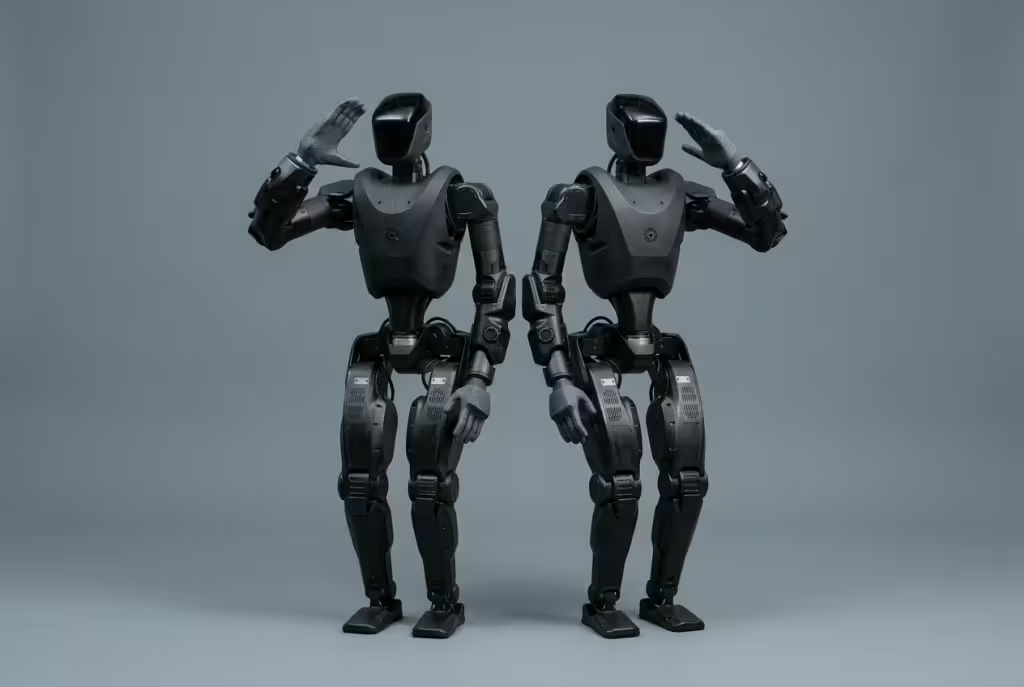
- The hardware: The flagship robot is the Phantom MK-1, a man-sized humanoid able to carry 40 kilograms, Pathak said. A second-generation model using chips from Advanced Micro Devices is in development. Foundation leases the robots at $100,000 per robot per year.
- Deployments so far: Foundation has deployed around 10 humanoid robots to date, Pathak said, including work with the Air Force, pilot programs in Ukraine where robots move objects around, and auto manufacturing deployments handling racking and unracking tasks.
- Production capacity: The San Francisco facility can produce between 300 and 500 robots a year, and a second site is being built to boost capacity. Asked about an earlier goal of 10,000 robots by end-2026, Pathak said those aims were pretty ambitious and the company is gearing up to build far more.
- The training path: Foundation first trains robots for outdoor jobs considered too dangerous for humans, using data gathered in warehouses and shipyards, then applies it to warzone training. Pathak said Phantom is close to learning a task after just a few human demonstrations.
- The technical gap: That falls short of a truly autonomous robot able to operate for long periods in unfamiliar environments with minimal human intervention, Pathak said. Reaching it would require a physical AI foundation model that understands the physics, kinematics and dynamics of the world.
- The expert caution: A recent Stanford University report underlined practical and ethical challenges around deploying robots on battlefields, citing unresolved questions on reliability, accountability, cost and cybersecurity of highly autonomous systems, and said their effectiveness in real-world operations is still being evaluated.
- The supply chain: In July, the U.S. banned most imports of new humanoid robot models as part of a push for an independent robotics supply chain. Domestic components must exceed 65% of a robot’s cost through 2028, rising to 75% in 2029. Foundation sources some parts from China and is adjusting to comply.
- The founder’s objection: Pathak said he does not believe a ban is the best route to closing the supply-chain gap, arguing it will not yield the results the government intends. The company did not set out a timeline for reaching full domestic-content compliance.
Background:
Unmanned aerial drones and ground vehicles are already deployed on the frontlines of military conflicts, and governments are increasingly exploring integrating artificial intelligence into defense. Humanoid robots would extend that shift from remote systems to machines built to enter buildings and operate on foot.
Between the lines:
The gap between the pitch and the hardware is wide: a 40-kilogram carrying capacity and roughly 10 deployed units sit against a stated ambition of 10,000 robots that Pathak himself now calls ambitious. Experts cited by the Journal see large-scale battlefield use as years away, with the Stanford report flagging accountability and reliability as open questions before autonomy reaches combat.
What’s next
Watch the outcome of the battle robot testing with U.S. defense forces, the rollout of the second-generation Phantom using AMD chips, completion of Foundation’s second production site, and the 65% domestic-content threshold running through 2028.