Key Points
- A viral trend has users asking AI tools to reimagine their selfies as 1980s photographs.
- Uploads to ChatGPT rebuild clothing, hair, lighting, furniture and film grain, not just apply a filter.
- Participation requires handing a clear facial image to an AI service, reviving data-retention concerns.
The latest:
Ordinary selfies are being fed into AI tools and returned as 1980s portraits, complete with oversized hair, aviator glasses, faded color and film grain. The trend has accelerated in recent days across Instagram, Facebook and X, with users uploading photographs to ChatGPT and prompting the system to recreate them as if shot four decades ago. Politicians and performers have joined in.
Details:
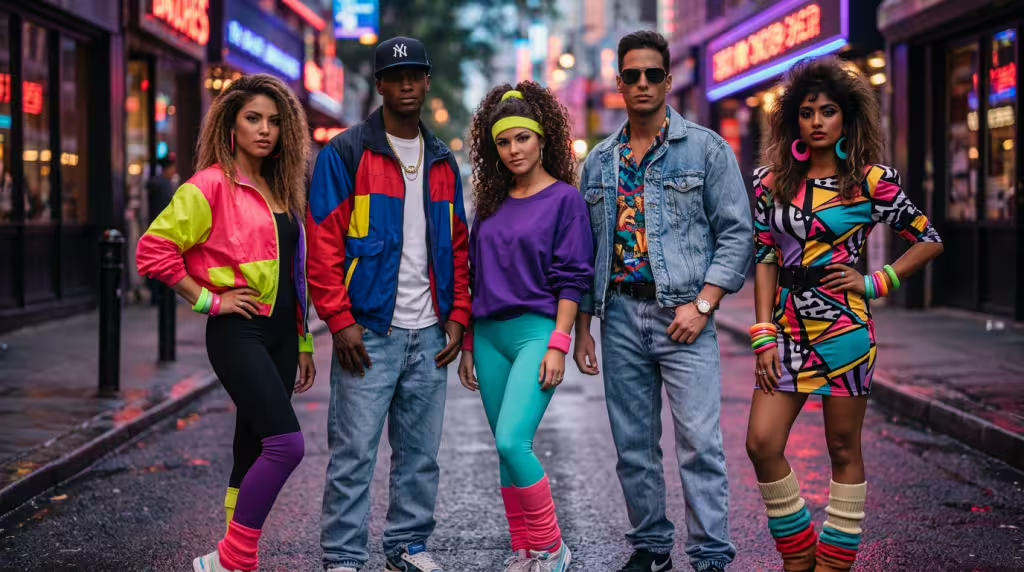
- How it works: Users upload a photograph, usually to ChatGPT, and ask for a version of themselves photographed during the decade. Unlike a conventional vintage filter, the system can rebuild nearly the entire frame: clothing, hairstyles, lighting, furniture, photographic style and the visual texture associated with old film stock.
- The look: Outputs are instantly recognizable — soft studio lighting, faded colors, vintage suits, old living rooms and wedding-album poses. The images resemble portraits that spent 40 years inside a family drawer, an aesthetic modern smartphone cameras were engineered to eliminate.
- Public figures: The trend has moved beyond anonymous accounts. Indian Commerce Minister Piyush Goyal posted an AI-generated retro portrait of himself, according to Indian outlets, while performers and influencers in several countries have shared their own imagined 1980s versions.
- The technical paradox: Modern phones deliver sharp faces, automatic color correction and computationally reconstructed low light at no marginal cost. The viral images voluntarily reverse all of it, adding blur, grain, faded color, softened faces and the accidental lighting that decades of engineering were designed to remove.
- The term: The phenomenon is sometimes described as anemoia — nostalgia for an era a person never personally experienced. Many of the users generating 1980s portraits of themselves never lived through the decade, which distinguishes this wave from conventional nostalgia among older audiences.
- Wider retro shift: The Financial Times noted a broader Gen Z turn toward analogue objects and retro aesthetics, from physical media to deliberately imperfect cameras. The outlet described part of the movement as a search for authenticity and permanence in response to an increasingly virtual world.
- Scarcity argument: A modern photo library may hold 30,000 images while an old family album held roughly 200, a contrast cited as one reason vintage-looking pictures feel weightier. The trend effectively manufactures that sense of scarcity on demand, without any of the underlying cost.
- Privacy concerns: Taking part generally means uploading a clear photograph of one’s face to an AI service, reviving questions about image retention and how technology companies handle personal data. Coverage in Morocco and Brazil has already flagged what users surrender to join a viral challenge.
- Not literal longing: The trend is read as consumption of an aesthetic memory rather than a wish to return to the decade itself, which carried its own economic, political and social anxieties. Record shops, cassette tapes, denim jackets and television glow supply the visual vocabulary.
Between the lines:
The trend turns generative AI against the digital moment it accelerated. A technology built to produce unlimited flawless images is being instructed to add grain, bad exposure and dated clothing so pictures read as more human. The nostalgia is synthetic; the facial data users hand over to obtain it is entirely contemporary.
What’s next
Watch whether AI providers clarify retention policies for uploaded facial images, whether regulators in markets where the trend spread open inquiries, and whether the format fades as quickly as earlier AI-image crazes.