

Key Points
- Details shown to US lawmakers describe a route to Saudi enrichment nearing 20%, the WSJ reported
- The July 123 Agreement sets a two-year joint study before any enrichment facility is built
- Nonproliferation experts warn 20% moves Riyadh far closer to weapons-usable material
The latest:
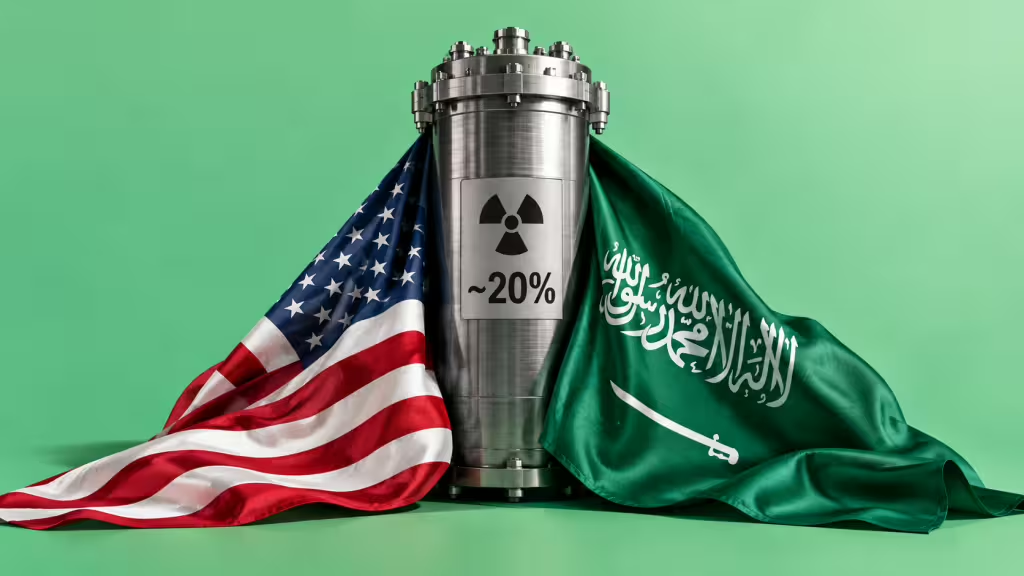
A civilian nuclear agreement between the Trump administration and Saudi Arabia lays out a path that could eventually allow uranium enrichment on Saudi soil at levels approaching 20%, according to details presented to US lawmakers last week and reported by The Wall Street Journal. Nonproliferation specialists reviewing the terms flagged escalation risks. President Donald Trump wrote in July that the deal would permit no enrichment at all.
Details:
- The mechanism: The so-called 123 Agreement, signed in July, provides for a two-year joint US-Saudi study of enrichment and conversion examining economic feasibility and safeguards, according to the WSJ. Only after that study, and only if both sides agree, would the enrichment question advance.
- What is allowed now: During the study period Washington may sell reactors to Saudi Arabia but not enrichment technology, the WSJ reported. If the two governments later concur, American companies and their partners would build a facility enriching to 5%, with subsequent studies able to push that toward 20%.
- The expert warning: Scott Roecker of the Nuclear Threat Initiative said enrichment at 20% could have a civilian rationale, powering a small modular reactor, but brings Saudi Arabia substantially closer to weapons-usable material, which he said requires strict controls.
- The Iran benchmark: Under the 2015 nuclear deal, Tehran’s enrichment was capped at 3.67%. After Washington withdrew during Trump’s first term, Iran raised enrichment to 60% before this year’s American and Israeli strikes. Roughly 90% is considered bomb-grade.
- Trump’s position: Trump wrote in July that the agreement would not permit any enrichment, the WSJ reported. He nonetheless signed a memorandum endorsing the pathway that could ultimately lead to enrichment on Saudi territory.
- The congressional gap: Critics including Representative Brad Sherman argue Congress has no realistic chance to block a final enrichment decision. Killing the agreement would require a two-thirds majority in both chambers; otherwise it takes effect automatically after 90 legislative days.
- The IAEA line: In Vienna on Monday, agency Director General Rafael Grossi said the agreement does not include Saudi accession to the Additional Protocol, the highest UN inspection standard, which Iran accepted under the 2015 deal, Reuters reported.
- The Saudi offer: Grossi said Riyadh is preparing bilateral verification and monitoring powers covering enrichment, conversion and reprocessing that come very close to those under the Additional Protocol. Final details are to be presented to the agency’s 35-nation Board of Governors.
Background:
The 123 Agreement is the US legal instrument governing civilian nuclear cooperation with foreign partners. Washington has historically pressed such partners to forgo enrichment and reprocessing on their own territory, the standard that made the Saudi file contentious for years.
Between the lines:
Two tracks are being negotiated in parallel and they do not fully align. The enrichment ceiling remains open to future revision, while the inspection regime Grossi described is bilateral and near-Protocol rather than the full Additional Protocol Iran accepted. That combination is what nonproliferation critics are targeting, given that the congressional route to blocking a final enrichment decision requires a two-thirds majority in both chambers.
What’s next
Watch the 90-legislative-day clock on the agreement, the final verification package Grossi said will go to the IAEA’s 35-nation Board of Governors, and the outcome of the two-year US-Saudi enrichment and conversion study.


