Key Points
- Iranian missiles and drones exposed Gulf bases’ vulnerability, prompting US forces and aircraft to shift westward.
- Washington must choose between multibillion-dollar repairs and a smaller, dispersed military footprint.
- A drawdown could unsettle Arab allies while reshaping Washington’s decades-old regional security posture.
The latest
Six months of war have thrown America’s Gulf bases into doubt after Iran struck facilities near its shores with short-range missiles and drones. The attacks hit aircraft hangars, radar and resupply infrastructure, and command-and-control nodes, forcing Washington to move personnel and aircraft to Israel, Jordan and farther afield. US officials must decide whether to rebuild installations used for more than three decades or redesign the regional footprint around smaller, dispersed sites.
Details
- Repair bill: The American Enterprise Institute estimated in April that repairing damage to 11 US bases across seven Middle Eastern countries would cost about $5bn. The Pentagon has not included reconstruction in its estimates of the Iran war’s cost. The Fifth Fleet has used Diego Garcia as a substitute supply hub after damage to its Bahrain headquarters.
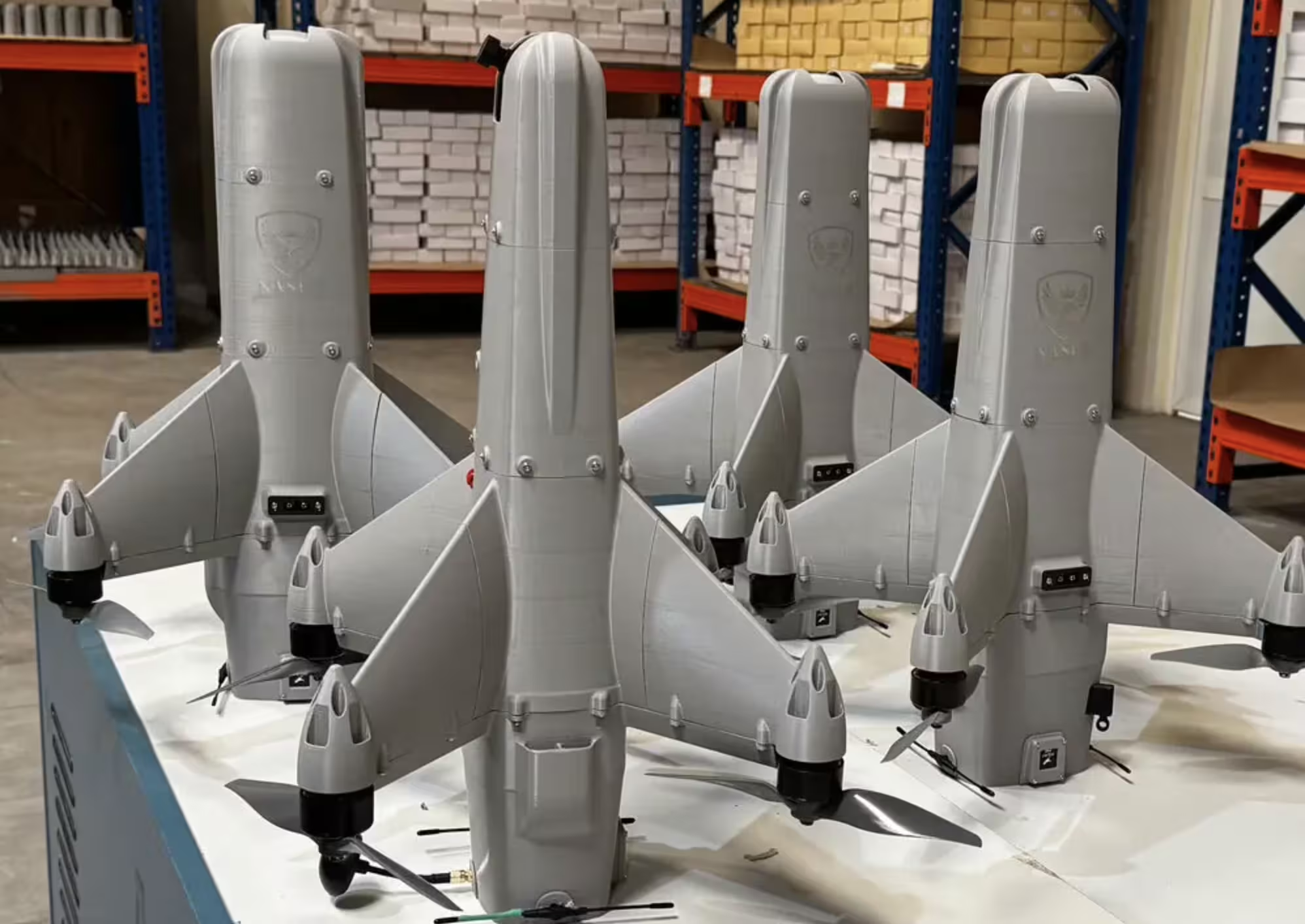
- Dispersed deployment: Pentagon planners increasingly favour deployments that make American forces harder to target over large, fixed operational and supply hubs. Central Command has experimented with scattering troops among smaller combat outposts and rapidly moving fighters between temporary runways. Hal Brands of Johns Hopkins University expects a shift beyond short-range missile and drone coverage.
- Forces move west: The US has moved forces to Israel and Jordan and operated aircraft and drones from European bases beyond the reach of Iranian weapons used regionally. Nate Swanson, a former National Security Council Iran director, said rebuilding unwanted installations could accelerate the westward shift.
- Troop numbers: About 35,000 US military personnel normally rotate through Saudi Arabia, the United Arab Emirates, Bahrain, Qatar and Kuwait. Three former US defence strategists expect that number to fall towards pre-2003 Iraq invasion levels, with consequences for Washington’s security commitments to Gulf partners.
- Iranian adaptation: Danny Citrinowicz, a former Iran analyst with Israeli military intelligence, expects Tehran to invest more heavily in medium-range missiles capable of reaching Jordan and Israel. Iran views prolonged confrontation with Washington as increasingly inevitable and is expected to adjust its forces as American deployments move farther from the Gulf.
- Reduced requirements: Washington’s withdrawal from Syria in April 2026 and gradual reduction of its anti-Isis presence in Iraq have weakened the operational rationale for some Gulf facilities. Many activities based in Kuwait had supported missions in those neighbouring theatres, while the broader US strategic focus has increasingly shifted towards the Pacific.
Background
The US military presence expanded after the Soviet invasion of Afghanistan and overthrow of Iran’s Shah in 1979. President Jimmy Carter declared in January 1980 that Washington would use force to prevent a hostile state controlling the Gulf. Permanent bases grew substantially after Iraq’s defeat in the first Gulf war.
What’s next
Washington must decide whether to fund roughly $5bn of repairs or move more troops and aircraft westward under the Pentagon’s dispersed model. Any plan must set the personnel and assets needed to support Gulf partners without creating the perception of abandonment.