
The latest
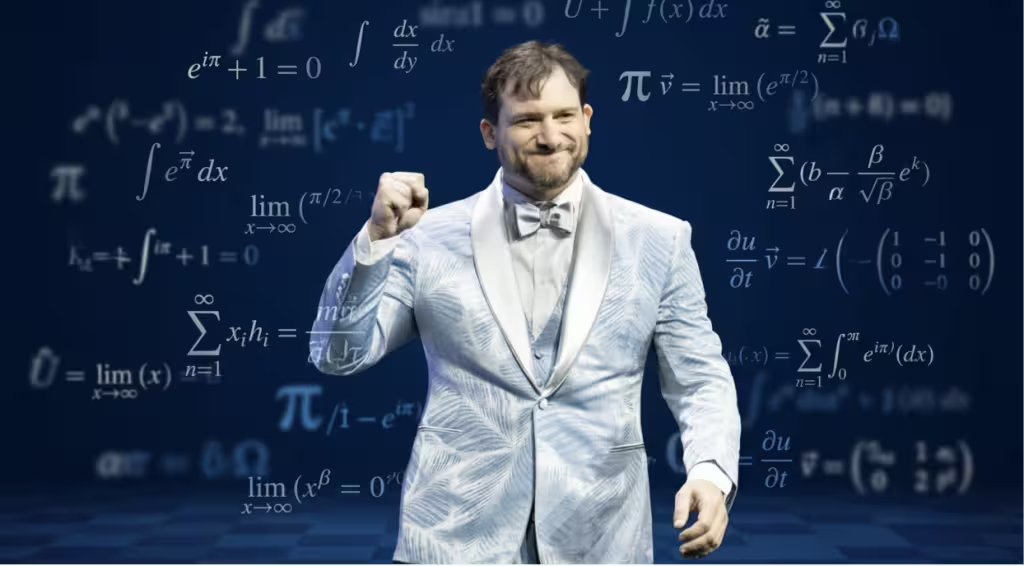
Jacob Tsimerman did not join OpenAI because artificial intelligence promised another technical frontier. He joined because its progress worried him enough to make safety the most urgent problem of his career. Days after receiving the Fields Medal, mathematics’ highest honour, the 38-year-old researcher announced that he would take leave from the University of Toronto to work at OpenAI. Tsimerman has written about scenarios in which AI could lead to human extinction. His aim is not to leave mathematics behind, but to apply its language of proof and verification to a practical question: how can people understand what advanced systems are doing and establish that they will not act against human intentions?
Details
- The announcement: Tsimerman revealed his move after the Fields Medal ceremony, when the four winners were asked about their next steps.
- Academic path: Born in Russia, raised in Israel and Canada, he won two International Mathematical Olympiad gold medals, earned a Princeton doctorate, taught at Harvard and became the University of Toronto’s youngest mathematics professor.
- Original field: He built his reputation in number theory and complex algebraic geometry before concerns about AI pushed him to reconsider his research priorities.
- Turning point: Tsimerman said he long doubted that AI could replicate human intuition and creativity, but changed his view after using ChatGPT in 2022.
- Risk research: Last summer, he published a paper categorising AI-related “omnicidal futures,” examining ways increasingly capable systems might create existential risks.
- Mathematical tools: He believes formal proof and verification methods could help evaluate model progress, interpret their decisions and create stronger safeguards around their behaviour.
- Practical use: Tsimerman recently asked a model to help generalise one of his mathematical arguments. It identified an error he then corrected, a capability he said would not have been possible a year earlier.
- Rapid progress: The report points to AI systems solving longstanding mathematical problems, reinforcing his view that the field is moving at extraordinary speed.
- Safety pressure: Recent security incidents involving OpenAI and Anthropic agents have also underscored the difficulty of containing increasingly autonomous systems during testing.
Between the lines
Tsimerman’s move shows that the contest for AI talent is no longer limited to software engineers. Frontier companies also need researchers capable of asking harder questions than how to build a faster model: what can be proved about its behaviour, and where do technical capability and verifiable limits meet?
What to watch
Tsimerman does not know how long he will remain at OpenAI or when he will return to teaching. His work will test whether mathematical approaches can keep pace with systems advancing rapidly in reasoning, coding and scientific research. The goal is not to stop AI, but to keep it understandable and controllable as its capabilities expand.