
The latest
Milton Avery, known for flat and richly coloured figurative scenes, can seem an unlikely companion to Gottlieb and Rothko, who became closely associated with abstraction. “Avery, Gottlieb & Rothko: By the Sea” returns their connection to Gloucester, America’s oldest continuously operating seaport, where the three spent summers painting and talking through their work in the 1930s and 1940s. Drawing on works rarely seen in public, the exhibition places the sea, harbour and beach at the centre of a shared experience that shaped three distinct ways of thinking about colour and form.
Details
- Curatorial premise: The exhibition was assembled by Eliza Rathbone, chief curator emerita at the Phillips Collection, after research into paintings and drawings held by institutions and the artists’ families.
- Scale: It brings together more than 80 works, including several not previously shown publicly, before moving to the Phillips Collection after its Cape Ann run ends on September 27.
- Avery’s beginning: Avery first arrived in Gloucester in 1921. His early work shows Impressionist leanings before shifting later in the decade toward flatter scenes with less visible brushwork.
- Shared summers: By 1932, all three were spending summers in the town, painting the harbour, docks and shoreline by day, then discussing their work at night, with Avery initially serving as a mentor.
- Gottlieb’s harbour: Gottlieb was drawn to the port’s industrial character, shells and sea debris arranged in crates—motifs that helped lead toward his later pictograph series.
- Rothko before colour fields: Rothko’s Gloucester works include darker, realistic views of the waterfront and workers, followed by a growing interest in Surrealism and myth in the early 1940s.
- Avery’s reduction: Avery remained closest to the visible world, but increasingly reduced landscapes to broad blocks of colour. In “Lone Rock and Surf” from 1945, the scene is almost distilled to white waves, a black rock and a strip of pink sky.
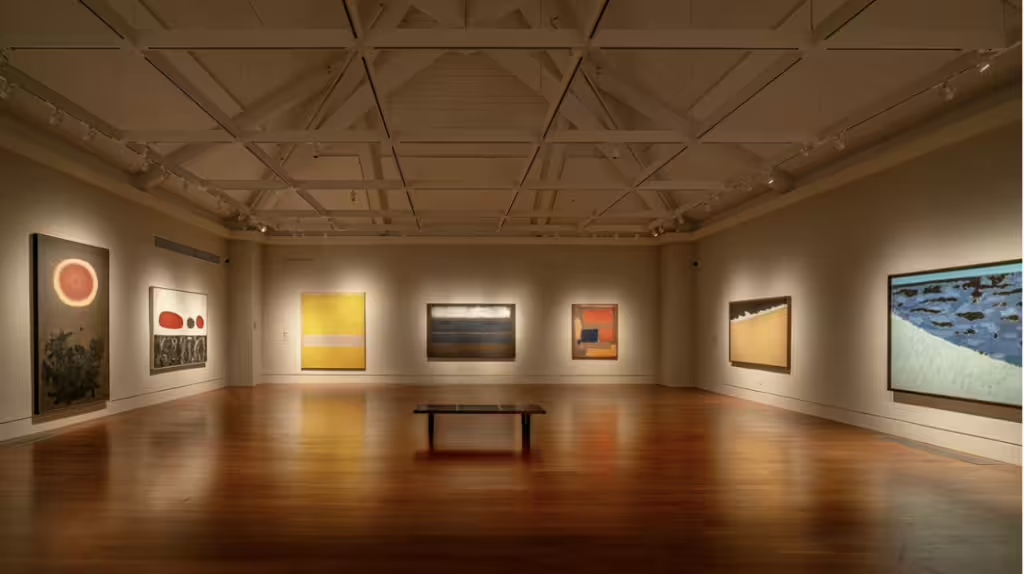
- The final gallery: Late works by all three artists are placed on facing walls, making the echoes of sea, colour and simplified form visible across styles that at first appear distant.
Between the lines
The exhibition’s achievement is not simply to show that three artists painted the same place. It shows how ideas can travel among friends without erasing their differences. Gloucester did not produce one style; it created a space of exchange in which Avery reduced the visible scene, Gottlieb turned it into signs, and Rothko moved gradually toward more psychological and abstract fields of colour.
What’s next
When the exhibition moves to Washington, its argument will be placed in a wider context through the Phillips Collection’s longstanding ties to all three artists. It leaves an enduring question: how can a local place and a handful of shared summers shape the longer trajectory of modern American art?