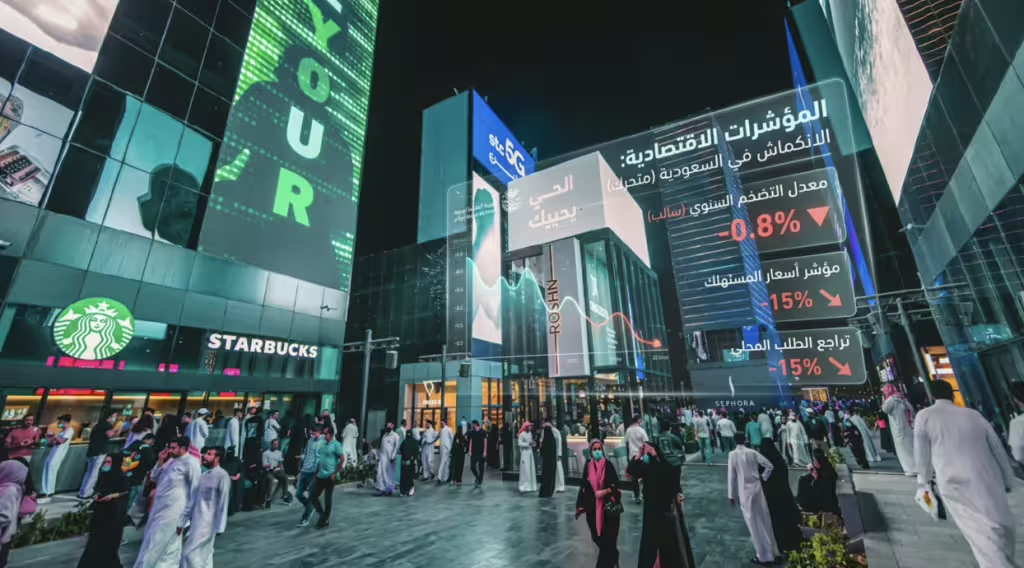
The number is not the whole story. Saudi Arabia’s contraction shows where the war’s real cost lies: in the ability of the world’s largest crude exporter to get its barrels to market, not simply in the price of oil. Prices rose above $90 a barrel, but that did not offset lower output and disrupted shipping. When the export route narrows, more expensive oil can still become harder to sell.
Iran’s effective closure of the Strait of Hormuz forced Riyadh to rely on a pipeline to Yanbu on the Red Sea. But that alternative route is not fully secure: Iran-backed Houthi threats have made the Red Sea a riskier corridor as well. Oil activity therefore fell 24.7% in the second quarter, after growing 2.9% in the previous quarter. Non-oil activity, the centerpiece of Saudi diversification, expanded just 0.6%, down from 2.9%.
That comparison is the key. Non-oil sectors did not collapse, but they could not offset the oil shock. It helps explain why Saudi Arabia appears better placed than some of its Gulf neighbors to absorb the crisis without being immune to it. Alternative logistics, government spending and consumption provide a cushion. They do not erase the fact the war has brought back into focus: The economy breathes more easily when oil exports remain open.
Details
- Overall growth: Gross domestic product contracted 4.8% year on year from April through June, following 3% growth in the first quarter.
- Oil activity: The oil sector recorded the steepest fall, declining 24.7% from the same quarter a year earlier.
- Non-oil activity: It grew by just 0.6%, marking a sharp slowdown from the previous quarter.
- The Strait of Hormuz: Disruption in the waterway forced Saudi Arabia to use its pipeline to Yanbu on the Red Sea coast.
- The alternative route: The Yanbu pipeline does not fully solve the problem because Houthi threats have also made Red Sea shipping more dangerous.
- Oil prices: Brent crude climbed above $90 a barrel, but higher prices did not compensate for reduced export volumes.
- Saudi Arabia’s response: The kingdom joined strikes this week against Iran-backed armed groups in Iraq, a rare move that reflects the widening conflict.
- 2026 outlook: Monica Malik expects the Saudi economy to grow by about 1% this year, compared with 4.5% in 2025.
- IMF forecast: The International Monetary Fund expects 1.7% growth in 2026 and an acceleration to 5.5% the following year if maritime traffic gradually normalizes.
Between the lines
War does not test an economy’s strength through the oil price alone. It tests whether the economy can keep moving when oil’s route is blocked. Saudi Arabia has alternatives, but the crisis has exposed their limits: One pipeline cannot replace a normal maritime corridor, and the non-oil economy cannot yet carry a shock of this scale on its own.
What to watch
The next indicator is not a growth release but tanker traffic. A gradual and safe return to Hormuz would ease pressure on output and support non-oil activity. Any attack on export infrastructure or disruption to the Yanbu route, however, could turn a quarterly contraction from a temporary consequence of war into a direct test of Saudi Arabia’s ability to protect growth and its economic diversification plans.