
The latest
In an industry that measures success by how many cars are sold, Ferrari has built its success around how few it sells. The company did not need higher production to raise its outlook. It needed F80 deliveries to reach customers and buyers to spend more on bespoke options. Each limited-run car becomes a financial event: A few dozen deliveries can alter the revenue mix because price is not a detail of the product. It is part of the product itself.
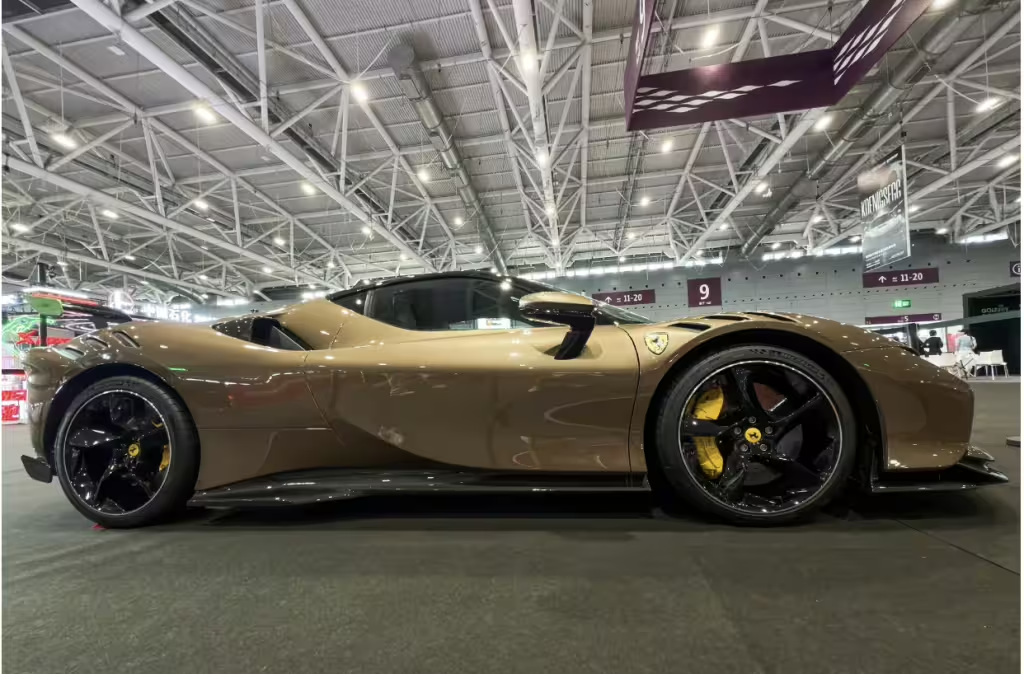
That formula is clearest in the F80, the 1,200-horsepower hybrid supercar priced at €3.6 million and limited to 799 examples. Deliveries began late last year, and analysts estimate Ferrari sold between 60 and 70 during the second quarter. Alongside it, the Handling Speciale version of the Purosangue gives buyers a V12 engine, sharper driving settings, distinctive styling and more expensive personalization options, without forcing Ferrari to expand production.
Adjusted earnings before interest, taxes, depreciation and amortization reached €755 million in the second quarter, while revenue totaled €1.94 billion. Yet the strength of special models does not answer the next question. The F80 will not lift earnings indefinitely, and Ferrari is preparing to sell the Luce, its first fully electric car. It has four doors and five seats, but none of the mechanical sound and combustion-engine drama that has shaped much of Ferrari’s appeal.
Details
- Earnings outlook: Ferrari raised its forecast for adjusted EBITDA to at least €2.97 billion this year.
- Sales outlook: The company now expects annual revenue of about €7.6 billion, up from its previous €7.5 billion forecast.
- Quarterly profit: Adjusted EBITDA reached €755 million, exceeding analysts’ expectations.
- The key model: The F80 costs €3.6 million, is limited to 799 cars and belongs to Ferrari’s line of rare halo models.
- The scarcity effect: A few dozen deliveries can lift revenue and profit at a pace ordinary vehicles cannot match.
- Purosangue: The new variant retains a V12 engine while adding driving settings, styling changes and higher-value customization.
- Market performance: Ferrari shares fell 1.1% in Milan after the results but remain up 6.1% so far this year.
- The electric car: Reports said the Luce reached its 2026 sales target of just under 500 units, though Ferrari has not disclosed official figures.
- The acceptance test: The Luce received a muted response when unveiled in May, despite management saying it has attracted new customers across markets.
Between the lines
Ferrari is not simply selling rare cars. It is selling limited access to its world. That is what protects its margins when deliveries slow. The electric car will test whether that access is tied to the badge alone, or to the sensory experience of an engine that is no longer there.
What to watch
The Luce’s trajectory will show whether Ferrari can carry its scarcity into the battery era. If it preserves waiting lists, personalization and high prices, the company will have a new growth engine after the F80. If demand remains softer than expected, the market will return to its hardest question: What comes after the cars that cannot easily be repeated?
.