The latest
Qatar and Iran have resumed maritime trade between Iran’s Deir port and Qatar’s Al Ruwais port after a nearly 5-month halt, in a move that goes beyond shipping: it tests Doha’s ability to reopen an economic channel with Tehran after missiles, a gas shock and US-Iranian mediation on Qatari soil.
Details
• Maritime route: Iranian commercial attaché Abbas Abdulkhani said shipping between Deir and Al Ruwais resumed after coordination with Qatari authorities.
• Missile memory: Al Jazeera reported that a Qatari Interior Ministry official said 66 missiles were launched toward Qatar, with 114 reports of debris.
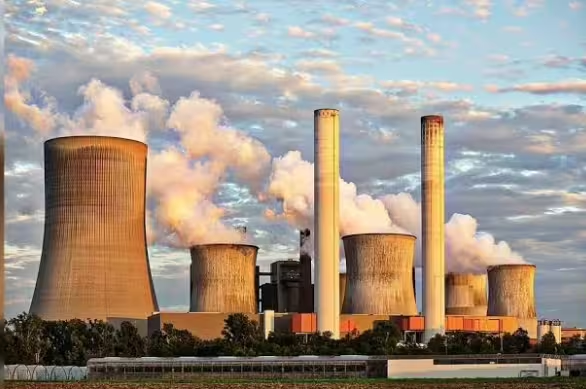
• Gas shock: Iranian attacks knocked out 17% of Qatar’s LNG capacity for a period that could last 3-5 years.
• Force majeure: QatarEnergy declared force majeure on LNG contracts after damage to 2 gas trains and a gas-to-liquids facility.
• Political thread: Gulf states, including Qatar, sent delegations to Khamenei’s funeral, while Doha remained part of the US-Iran track on Hormuz.
Background
The Deir–Al Ruwais halt was not an ordinary commercial interruption. During the war, Qatar became both a target and a guarantor: energy-linked facilities were hit in what Doha described as aggressive attacks, its position as a global gas supplier was affected, and it later returned to hosting a negotiation channel between Washington and Tehran over navigation and Iranian funds.
Between the lines
Qatar has reopened a small route with a state that struck its territory and threatened one of its most important sources of power: gas. That makes Al Ruwais more than a northern port. It becomes a test instrument for a Qatari policy built on keeping danger close enough to negotiate with, not distant enough to explode.
The missile numbers change the meaning of the story. When Doha resumes maritime trade with Tehran after that scale of attack, it is not declaring political amnesia. It is saying that a total rupture with Iran is a luxury unavailable to a state tied to the region’s largest gas equation and dependent on the security of maritime routes.
Doha is separating 3 levels: damaged security, an economy that must keep moving, and mediation that gives Qatar strategic value in Washington and Tehran at the same time. In that equation, anger alone does not protect Qatar. An open channel may do more.
For Tehran, the resumption of the Deir–Al Ruwais route offers a sign of partial exit from Gulf isolation after the war. For Doha, the route is not a bet on Iranian goodwill. It is a low-cost line of contact with a dangerous neighbor that can threaten gas, straits and markets.
The paradox is harsh. According to the available information, Iran has not offered a clear apology or announced compensation for damage to energy sites and other civilian infrastructure. Yet Doha is hosting Hormuz-linked talks, sending official representatives to Tehran, and restoring trade. This is not comfortable normalization. It is the daily management of a contradiction that cannot be solved in one move.
What to watch
This track will be measured by the volume of shipping between Deir and Al Ruwais, the stability of Qatari gas exports, the fate of force majeure, the resumption of Doha talks after Khamenei’s funeral, and whether Iran links Hormuz to fees or arrangements that directly affect Qatar.