Details
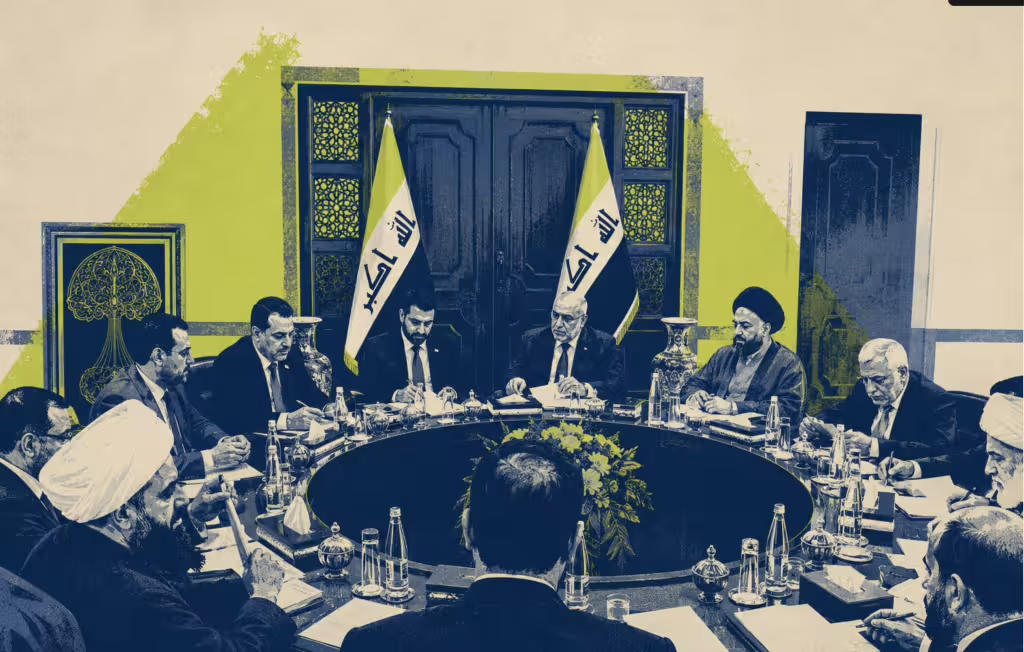
A source close to Iraq’s Coordination Framework said some of its leaders now see the latest corruption campaign as a political opening, not only a judicial process.
According to the source, figures inside the Framework are discussing whether to use the public and judicial momentum behind the campaign to push for dissolving parliament and holding early elections. The goal would be to reshape the parliamentary map before damaged blocs recover.
The opening came from the judiciary’s own language. It said the investigations involved candidates who spent “huge sums of money” on election campaigning by exploiting state resources and receiving support from influential figures in the previous government.
That sentence widened the political battlefield:
- If state money was used in election campaigns, the legitimacy of some seats could come under pressure.
- If figures from the previous government helped finance those campaigns, the political burden will move closer to Sudani’s network.
- If the investigations expand across Sunni and Shiite blocs, the case could become a parliamentary reset, not a limited campaign against individuals.
- If the judiciary keeps setting the pace, damaged factions will struggle to frame the campaign as a purely government-led targeting operation.
Politically, the source sees Sudani as the biggest loser.
Not only because some names are seen as close to his camp, but because the judiciary’s statement referred directly to “influential figures in the previous government.” That phrase alone puts pressure on Sudani’s legacy and on the electoral network built around his time in office.
The second loser, according to the source, is Azm.
The arrest of Muthanna al-Samarrai — or even his placement among the most prominent names linked to the campaign — hits one of the most influential Sunni players in parliament. It also opens new competition inside the Sunni arena, especially as political suspicion circles around Taqaddum leader Mohammed al-Halbousi, even though no direct charge against him has been proven in this track.
But the story does not stop at corruption.
Inside the Framework, some now see Prime Minister Ali al-Zaidi as stronger than he was when his government was formed. He has support from influential Framework members and benefits from the backing of the head of the Supreme Judicial Council, whom the source describes as the key driver of events behind the scenes.
Al-Zaidi does not only have the momentum of an anti-corruption campaign. He also has judicial cover that makes his rivals move carefully. According to the source, he is also trying to gain acceptance from the U.S. side by presenting himself as a figure capable of curbing corruption and reorganizing the state.
The damaged factions, meanwhile, are looking for ways to restrain him.
- Some want to contain the campaign within specific files and prevent it from reaching first-tier leaders.
- Some are considering using parliament to question the government or slow its push.
- Some are trying to rebuild cross-sectarian alliances among Shiite and Sunni figures hurt by the campaign.
- Others are betting that the campaign will lose momentum, as past Iraqi anti-corruption drives often did.
But time is not working equally for everyone.
Every new arrest warrant weakens a political bloc. Every senior name entering the investigation raises public expectations. Every judicial reference to illegal campaign financing makes early elections easier to sell.
Iraq is now in an open race.
One camp inside the system wants to turn the corruption campaign into a founding political moment that cuts down rivals and redistributes seats. Another camp wants to stop the drive before it becomes an electoral and judicial weapon capable of toppling entire balances.
What to watch
The key indicator will be the judiciary’s next targets. If the campaign reaches first-tier figures, early elections could become a serious option inside the Coordination Framework. If the case is contained at the level of MPs and brokers, it may become a major pressure round that ends in another internal settlement.