Details
- Iraqi economic expert Ziad al-Hashemi says the current anti-corruption campaign cannot be separated from the financial pressure facing the Iraqi government.
- According to al-Hashemi, the steady flow of oil revenues under previous governments allowed corruption to remain a postponed or politically managed file, shaped by interests and power calculations.
- The current government, he argues, came to power in a different environment: regional war tensions, disruption to part of Iraq’s oil exports, a nearly depleted treasury and major spending obligations.
- Under those conditions, al-Hashemi says, the government had few options but to try to recover some of the public funds stolen over the past years.
- He views the campaign as an unprecedented step since 2003, but still below the required level as long as it targets the “tools of corruption” rather than the “sponsors of corruption.”
- Al-Hashemi warns that if the political and administrative sponsors of corruption remain beyond accountability, the system will be able to reproduce itself. Every time one tool falls, the networks protecting it can simply replace it with another.
- In its first official response, Iraq’s Federal Integrity Commission said it had begun implementing judicial arrest warrants against several suspects accused of violating public funds.
- The commission said the measures were the result of coordination among the judicial, executive and legislative authorities, stressing that all procedures were being carried out under the law.
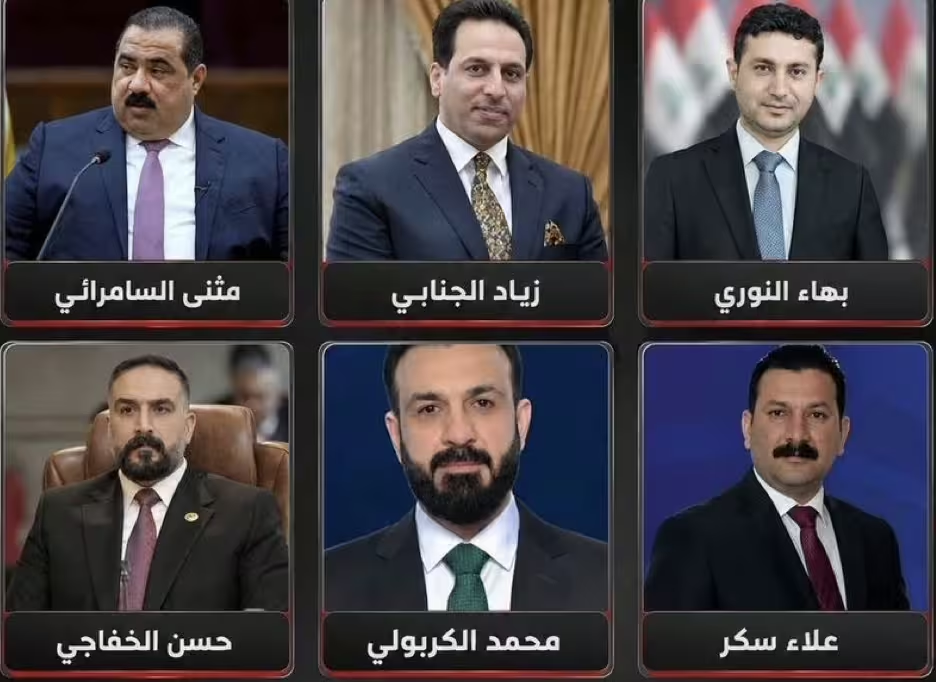
- According to the Iraqi News Agency, the campaign covered 47 suspects, including lawmakers and officials, based on statements given by Deputy Oil Minister Adnan al-Jumaili, with pursuit operations continuing in Baghdad and other provinces.
- Sources from the Integrity Commission told +ontime that the Karkh Second Court had summoned a first-tier political figure to appear and give testimony after the figure’s name surfaced in preliminary investigations involving a suspect who is a member of Iraq’s parliament.
- The source said the summons was a routine legal procedure and did not amount to a direct accusation, adding that the request was sent under Iraq’s Code of Criminal Procedure.
- The source expected the political figure to avoid appearing for now, but said it was still more likely that the figure would eventually provide testimony.
- Asked about leaked images showing raids on suspects’ homes and seized items, the source said some of the leaks were the result of individual mistakes, while some circulated images were “not real.”
- Images of suspects and cash piles had spread widely on social media, with users claiming they were seized from the homes of those targeted. One image showed bundles of $100 bills allegedly linked to one of the accused women.
- Politically, former Prime Minister Nouri al-Maliki emerged with a public show of support for the campaign. In a post on X addressed to Prime Minister Ali al-Zaidi and the judiciary, he wrote: “We congratulate you on the Dawn Campaign to pursue the corrupt who tampered with the Iraqi people’s money,” adding: “Continue this mission until the end.”
- Maliki also described the campaign as “a long-awaited step for the Iraqi people,” declaring support for strengthening justice and holding accountable those who abused public trust.
- But Maliki’s position triggered broad reaction because his name has long been at the center of political and public accusations related to corruption and mismanagement of public funds during his time in power, although no final judicial ruling has established his personal responsibility in those cases.
- The corruption file during Maliki’s years in office remains a recurring subject in Iraqi political debate, with reports and analyses pointing to major losses in public funds during that period. Much of the criticism, however, has remained within the political and media sphere rather than being settled by final court judgments against him.
- In that context, it was notable that Maliki’s X account limited replies to the post, displaying a message that only some accounts could respond. The restriction came at a moment when the post was expected to draw criticism from Iraqi users who associate his name with corruption and mismanagement.
- The current campaign is one of the widest moves against politicians and officials in Iraq in recent years. It included raids in the Green Zone and arrests of political and parliamentary figures linked to corruption investigations that began with the detention of Adnan al-Jumaili.
What’s next?
The campaign places Iraq’s government before an early and sensitive test. If the measures remain confined to corruption tools and some executive fronts, they may end as a limited political pressure wave.
But if investigations expand toward the sponsors of corruption and the networks that provided political and administrative protection for years, the campaign could become a defining moment in the Iraqi state’s relationship with public money.
The key question now is whether the government and judiciary can carry the campaign through, or whether it will stop at the limits of the political balances that have long protected Iraq’s corruption system.