U.S. President Donald Trump announced that he was suspending his threat to strike Iranian energy plants until April 6, 2026, saying the decision came after a request from the Iranian government and that the talks were going well.
But that is not the whole story.
The decision also came at a moment of intense market tension. Oil had already jumped by about 6% as fears of war rose and supplies through Hormuz were disrupted, while any signal that Iran’s power infrastructure might be hit would, in practice, have pushed the market into a fresh wave of anxiety. That is why it is difficult to separate Trump’s rhetoric from its function of calming the markets!
Detail
Open-source information supports four levels of interpretation:
The Iranian request was real in the American narrative.
Washington wanted political and economic time.
Gulf pressure was present in the background.
In the past few days, missile and drone attacks suddenly stopped breaching Qatari airspace, so Doha moved faster than some of its neighbours in restoring in-person attendance, returning students to classrooms, and normalising daily life after the alerts stopped and no new ballistic attacks were recorded.
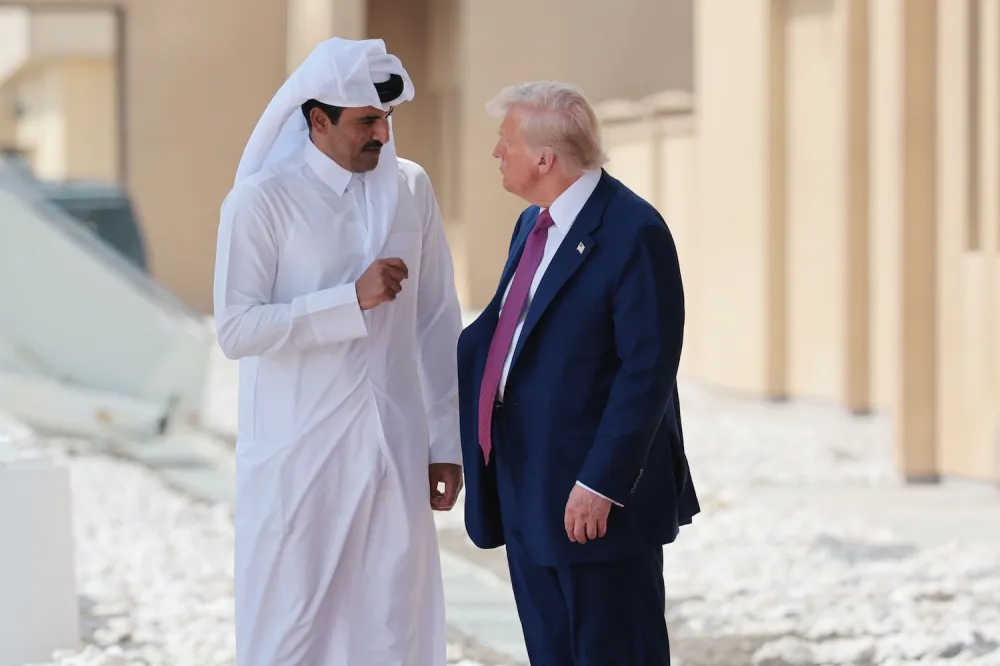
Meanwhile, Doha repeated that it is not a direct mediator between Washington and Tehran, but that it supports all formal and informal efforts to end the war.
Qatar saw that continued attacks against it were raising the cost for everyone.
The attack on Ras Laffan disrupted 17% of Qatar’s LNG export capacity, while Tehran had justified some of its strikes as a response to the targeting of South Pars. At that point, the gas file became part of the core of the decision, but it does not explain everything on its own, because targeting Al Udeid could theoretically have continued as well.
If the shared gas field alone was the reason, then why did the pace of attacks on Al Udeid also decline?
The more likely answer is that the reason was not just gas, but the combination of three considerations:
• Rising global sensitivity around the energy file.
• The declining political and military return from striking Qatar after the first blow.
• Washington’s and some mediators’ desire to buy time before a bigger escalation.
As for the +ontime information from two sources, it adds another reason. The two sources say:
Doha requested an extension of the deadline as a directly affected state that wanted time to stabilise the de-escalation, while Iran would also help by giving a public signal that negotiations were continuing, which would ease market tension.
This information does not contradict the broader trajectory, especially since Iran, only hours after Trump announced the extension of his deadline, declared, according to Axios, that it was interested in negotiations, even though earlier on the same day it had described them as unilateral and biased and had said it rejected negotiations in general, as a senior Iranian official told Reuters.
What next?
The question now is: why did Trump delay the strike?
And the more precise question is: was the delay an attempt to buy time before a bigger strike if the talks failed, or was it Doha’s mediation?!
The available indicators suggest that both possibilities remain open at once:
•
(Analysis)
The closest explanation is that Trump told only half the truth.
Yes, Iran asked for time. But more likely, the decision also served American and Gulf needs at the same time:
• The market needed a calming message.
• The Gulf, especially Doha, needed to stop the momentum of the danger wave.
• And Washington needed extra time, whether to complete negotiations or to complete its positioning if negotiations failed.
In this context, the Qatari role, if the +ontime sources are correct, becomes very logical:
Not as an officially declared mediator in the way Pakistan, along with Turkey and Egypt, present themselves, but as an unofficial channel pressing for a short extension conditioned on an Iranian negotiating signal that would help calm the market and reduce the chances of a wider war.