

Key Points
- Google DeepMind says teams of Gemini 4 agents optimized known quantum algorithms, with every result proved in Lean.
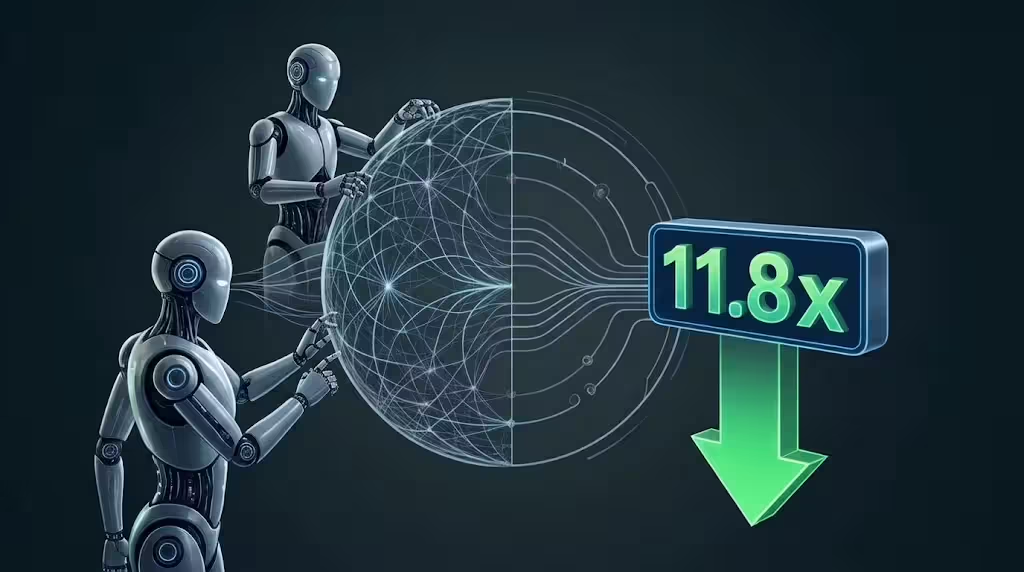
- A fusion-energy circuit's computing cost fell 11.8 times and its memory need from 5,650 to 4,338 error-corrected qubits.
- DeepMind says the circuits still exceed what the first error-corrected quantum computers are likely to provide.
The latest:
Teams of Gemini 4 agents improved well-known quantum algorithms and produced circuits whose computing cost for an inertial confinement fusion calculation fell 11.8 times, Google DeepMind said in a paper published November 23, 2026. The lab said each result was proved mathematically using Lean, a formal theorem prover, because the circuits cannot be tested on classical computers or on today’s small quantum processors.
Details:
- The method: DeepMind said it assigned separate, independent agent teams to each problem. Ideas were verified in Lean before entering a shared notebook, and every four hours agents from each team met at a virtual conference to trade, debate and compare ideas, with computational cost falling gradually until the experiment ended.
- The fusion result: The agents found a circuit that helps calculate an important property of inertial confinement fusion, a method using lasers to compress hydrogen fuel until ignition. The computing cost metric, combining required qubits and operations, fell 11.8 times, and memory dropped from 5,650 to 4,338 error-corrected qubits.
- Drug metabolism: For Cytochrome P450, an enzyme that breaks down most human medicines and matters for drug design, DeepMind reported a 2.5-times improvement and a reduction in memory from 481 to 333 qubits, achieved by replacing bulky memory lookups in the algorithm.
- Photochemistry: The lab said simulating a common light-sensitive molecule became 8 times cheaper, after the agents simplified how the algorithm tracks particle positions and electric forces. DeepMind described photochemical reactions as complex and difficult for classical computers to simulate.
- Core algorithms: DeepMind also reported a 2.57-times speedup for a specific implementation of Grover’s algorithm, a foundational operation that searches an unsorted list, and a 290-times speedup for arcsin, a routine used by many other quantum algorithms to load numbers into quantum states.
- The limitation: Running these algorithms in scientific simulations would still demand more computational resources than the first error-corrected quantum computers are likely to provide, DeepMind said, while describing the improvements as significant. The post did not give a timeline for when suitable hardware might exist.
- What is released: DeepMind said it is open-sourcing its Lean library, problem specifications and verified solutions on GitHub, describing the library as new and built for quantum algorithms so collaborating agent teams work with mathematical correctness guarantees.
- The human role: Researchers set the direction by specifying problems and supervising progress, the lab said, crediting knowledge of quantum algorithms combined with the agent team setup. The work is a collaboration between Google DeepMind and Google Quantum AI.
Background:
Quantum computers could solve problems beyond classical supercomputers, DeepMind said, but even the best quantum algorithms leave some important applications needing more resources than early quantum hardware can support. Circuits are the instructions telling a quantum computer how to carry out an algorithm.
Between the lines:
The authors frame the method, not the numbers, as the main claim: proof-checked AI search compresses work that once took years of manual design, letting researchers focus on choosing problems and interpreting results. That framing rests on the structure they describe — Lean verification gating every idea before it enters the shared notebook — and on their statement that the approach could accelerate other quantum computing research and scientific discovery.
What’s next
Whether outside researchers reproduce or extend the results using the open-sourced Lean library, problem specifications and verified solutions on GitHub, and whether error-corrected hardware ever reaches the qubit counts these circuits still require.