
Key Points
- Iranian state TV aired footage of an underground IRGC complex it called a missile city.
- German and Italian firms supplied tunnel-boring machines to Iran for declared civilian projects.
- Analysts say no public evidence links that equipment to Iran's military tunnel network.
The latest:
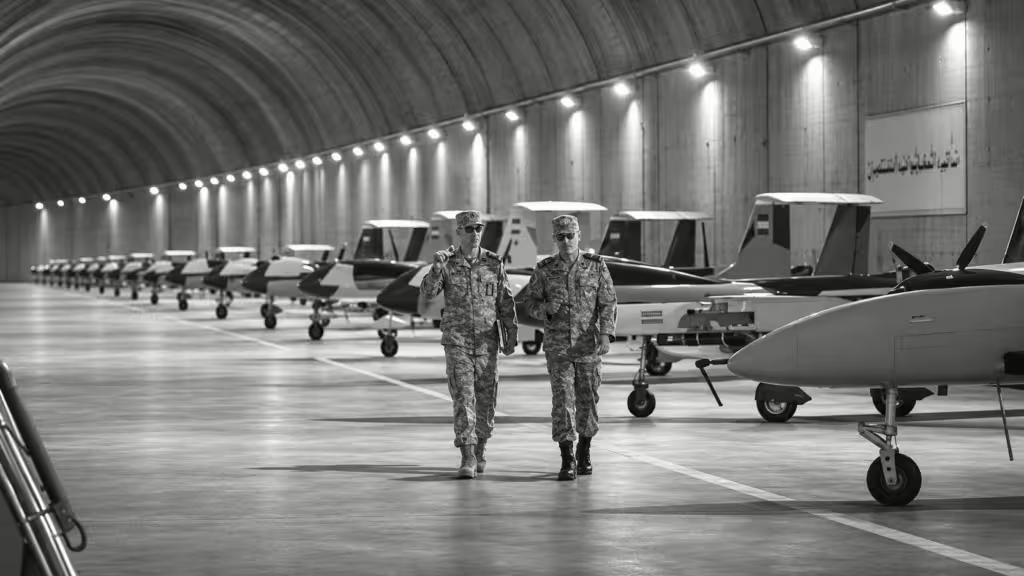
Iranian state television aired footage on Saturday of IRGC commanders driving through an underground complex it described as one of tens or possibly hundreds of missile cities, without disclosing its location. The broadcast has revived questions over how the tunnel network was dug and whether European-supplied boring machines were involved. The IRGC says its underground production centres can keep operating under heavy bombardment.
Details:
- The footage: The broadcast showed IRGC commander Ahmad Vahidi and Brig Gen Seyyed Majid Mousavi, head of the IRGC Aerospace Force, moving through the complex in an open-top tactical vehicle. State television said Vahidi was visiting for the first time and called the facility new, but gave no indication of when it was built.
- The new hardware: The same broadcast carried what state television called the first footage of a launcher able to fire two liquid-fuel missiles simultaneously. Mousavi said Iran’s aerospace capabilities had expanded in the interval between the two conflicts, a reference to the June 2025 war with Israel and the United States.
- The German supplier: Herrenknecht, among the world’s leading makers of tunnel-boring machines, confirmed to The National it supplied machines, equipment and services for Iranian metro and water infrastructure from the late 1990s. It said it rejected all new inquiries and withdrew from the market in summer 2018 because of the political situation.
- The company’s defence: Herrenknecht said its Iranian work was strictly limited to projects with a clearly civilian purpose and complied fully with national and European regulations, adding that Germany’s Federal Office of Economics and Export Control was informed in a timely manner about every single project it carried out in Iran.
- Other firms named: Germany’s Aker Wirth and Italy’s Seli have also been identified among foreign suppliers of tunnelling equipment for Iranian projects. Aker Wirth reportedly had three machines operating in Iran in 2009, including equipment for a water project managed by the IRGC. Both firms did not respond to The National’s requests for comment.
- The contractor: Khatam Al Anbiya Construction Headquarters, an IRGC-controlled conglomerate, works across civilian and military sectors through subsidiaries including Ghorb Nooh, Rahab and Sepasad. The UN Security Council described it as a prime contractor for Iran’s missile and nuclear programmes, and its subsidiaries were heavily involved in building the Fordow enrichment plant near Qom.
- The sanctions trail: The United States designated Khatam Al Anbiya in 2007, the European Union followed in 2008 and the UN in 2010. UN sanctions lapsed in 2023 and were reimposed in September 2025. The US Treasury’s February 2010 notice set out the group’s tunnel construction role but did not name contractors for individual missile factories.
- The caution: Gregg Roman of the Middle East Forum told The National that equipment transfers and military end-use require separate evidence, and a civilian tunnelling contract does not establish diversion. He added that protected storage, assembly and complete missile production are distinct capabilities, and surviving tunnels alone do not establish all three.
- The imagery: The Foreign Policy Research Institute said on October 14 that Iran kept excavating a new tunnel complex at Shahroud, a solid-propellant site where construction began in 2024, while questioning reports that underground assembly had resumed at Khojir. A CNN analysis of Airbus imagery in May found Iran had reopened 50 of 69 tunnel entrances struck at 18 sites.
- The coverage gap: Antonios Vlachos, founder of Athena Glaux Intelligence, told The National that since early November his firm logged 71 reports on the missile cities from 25 outlets in 15 countries, but only 19 mentioning tunnel-boring machines and nine naming Khatam Al Anbiya.
Background:
Tunnel-boring machines are enormous and hard to conceal in remote mountainous terrain, and their use typically leaves construction areas, access roads and spoil heaps visible from orbit. Iran’s inventory is poorly documented, and the location of European-supplied machines has been especially unclear since 2018, when several western firms exited.
Between the lines:
Vlachos argued the speed of the reopening — most struck entrances back in service within weeks — indicates the sites were engineered to survive strikes rather than merely to stay hidden. Analyst Daniel Schatz told The National that dispersing and hardening launchers preserves Iran’s ability to threaten Israel, Gulf states and shipping after a first wave, and said that precisely because attribution of individual tunnels is impossible publicly, dual-use transfers demand exceptional scrutiny.
What’s next
Watch for satellite imagery tying specific machines to missile sites, further excavation at Shahroud and Pickaxe Mountain near Natanz, and responses from Aker Wirth and Seli. An investigation by Iranian geologist Nik Kowsar on equipment movements through Yazd rests on one anonymous source.