Key Points
- Maria Cristina Terzaghi says a grime-covered Paris portrait is Caravaggio's Young Man with a Vase of Roses.
- The painting disappeared in 1831; four known copies survive, including one in Atlanta.
- If confirmed, it would restore a work missing for nearly two centuries to Caravaggio's slim catalogue.
The latest:
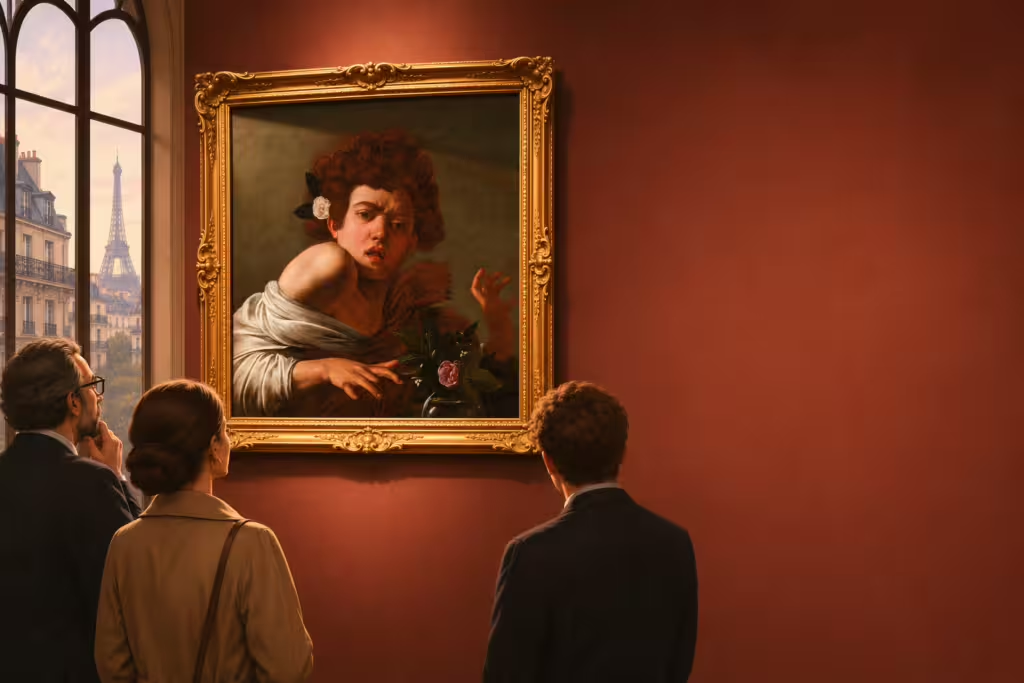
A portrait sitting in the back room of a Paris gallery is Caravaggio’s Young Man with a Vase of Roses, lost since 1831, according to Roma Tre University art historian Maria Cristina Terzaghi, who went public three years after being asked to examine it. She told The Times the quality left no doubt, pointing to a reflection in the glass vase she believes is a self-portrait.
Details:
- The claim: Terzaghi said she was asked three years ago to inspect the grime-covered portrait of a young man in a Paris gallery and concluded it was Caravaggio, citing the subject’s eyes and the painting’s quality. She has only now made the attribution public.
- The detail cited: She pointed to the reflection of a young man visible in the glass vase, which she said is probably a self-portrait embedded within the portrait, and described the eyes as sensual and suggestive of tears without the subject crying.
- The dating: The work is thought to have been painted in 1596 or 1597 while Caravaggio was working at a Rome artist’s workshop. Terzaghi said workshops at the time commissioned painters to depict the senses.
- The pairing: Terzaghi said the picture forms a pair with Boy Bitten by a Lizard, now in the National Gallery in London. In her reading, Young Man with a Vase of Roses represents smell and the London painting represents touch.
- How it was lost: By 1607 the workshop owner, accused of starting a street brawl that disfigured a painter, surrendered his collection to the Vatican, and the works passed to Cardinal Scipione Borghese. Sick Bacchus and Boy with a Basket of Fruit remain in the Borghese collection; the Vase of Roses vanished in 1831.
- The Paris trail: Terzaghi said the painting had been in Paris since at least the start of the 20th century, owned by a bookseller whose widow auctioned it in 1909 as the work of an unknown Italian painter. Descendants of the buyer are understood to still own it and prompted the provenance inquiry.
- Peer reaction: Paola Nicita of the National Gallery of Antique Art at Palazzo Barberini said she had not seen the work but that Terzaghi is one of the world’s leading Caravaggio experts and the painting absolutely needs study. Gallery director Thomas Clement Salomon said assessment will take time.
- Her record: Terzaghi helped identify Ecce Homo, which surfaced at a Spanish auction in 2021 attributed to another artist with an estimate of 1,500 euros. The Spanish government halted the sale and the picture was later exhibited as a rediscovered Caravaggio at the Prado in Madrid.
- The wider catalogue: The Italian government counts about 65 paintings attributed to Caravaggio, with numerous works lost and many claimed rediscoveries contested. Saint Matthew and the Angel, painted in 1602, was destroyed in Berlin in 1945.
- Another missing work: The Nativity with Saints Lawrence and Francis of Assisi was stolen from a Palermo church by the Sicilian mafia in 1969 and was reported to have been eaten by mice while hidden. Terzaghi said she hopes more missing portraits resurface.
Background:
Caravaggio reshaped European painting with naturalism, sharp contrasts of light and shade and emotionally charged subjects. Nicita said the early workshop pictures offered a glimpse into the souls of his sitters and built his reputation in Rome before he won church altarpiece commissions.
Between the lines:
The attribution rests so far on one expert’s visual judgment and a provenance trail that goes cold between 1831 and the early 20th century, with the 1909 sale listing an unknown Italian painter. Both Barberini officials stopped short of endorsing it, framing the work as worth studying rather than established. The contested history of past rediscoveries sets the bar.
What’s next
Watch for technical and scholarly examination of the canvas, any statement from the owning family on access or sale, and whether Italian or French institutions seek to exhibit the painting once study is complete.