The latest:
Senior Iranian officials seized on the Democratic sweep of both chambers of Congress to argue that American voters had turned against the war with Iran, now in its ninth month. Parliament speaker and chief negotiator Mohammad Bagher Ghalibaf wrote on X that Americans had said no to war and that Tehran backed the message. The region is waiting to see whether Washington resumes large-scale operations.
Details:
- The vote: Democrats won control of both chambers of Congress in Tuesday’s midterm elections. Concerns about the effects of the war, and in particular frustration over rising fuel and other goods prices inside the United States, contributed to the result, according to the account of the vote circulating in the region.
- The Supreme Leader: Mojtaba Khamenei said anyone still hoping that behavior change, or party and factional shifts inside the hegemonic system, could alter Washington’s hostility was gravely mistaken. He has not appeared publicly since the war began on February 28, and posted the message on social media.
- Hormuz strikes: The midterms followed what appeared to be a limited US strike on Iranian targets in the Strait of Hormuz. Iranian state media reported explosions Monday on Qeshm and Hengam islands and near Bandar Abbas. Iranian authorities did not officially announce the targeted sites or the scale of damage.
- The chokepoint: Roughly a fifth of global oil supply passed through the Strait of Hormuz before the war. Iran has imposed tight restrictions on navigation there since the conflict began, while the United States has enforced a naval blockade on Iranian ports. Commercial shipping incidents have been repeated.
- Netanyahu’s push: Two regional officials and a third person briefed on the matter said Israeli Prime Minister Benjamin Netanyahu pressed for another wave of strikes on Iran after the US elections during a weekend phone call with Trump. All three spoke anonymously, citing classified briefings and a lack of authorization.
- The draft framework: The two officials said diplomacy had made progress and that mediators are seeking a framework under which Iran halts its attacks in the strait in exchange for the United States lifting the blockade. Vice President JD Vance said Monday that he and Trump were “very optimistic” about a negotiated settlement.
- US forces: Thousands of American troops remain stationed off Iran’s coast to maintain the blockade preventing Iranian oil tankers from reaching the global market. Another aircraft carrier and thousands of additional troops are heading to the Middle East. Before the latest strikes, the last known attacks were in early September.
- Parliament’s reading: Deputy parliament speaker Ali Nikzad told lawmakers Wednesday that US sanctions had failed to cripple Iran’s economy or force its people to surrender. He said enemy efforts to bring down the economy had failed repeatedly, and described the election outcome as an aftershock of a defeat inflicted by Iranians.
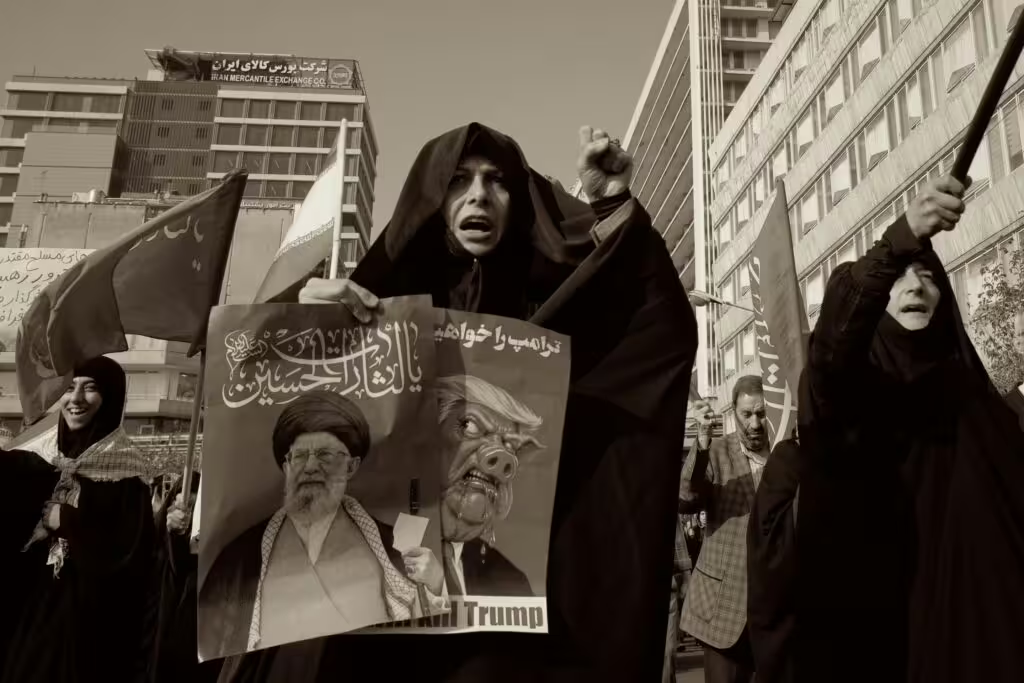
- Embassy anniversary: Thousands marched in Tehran Wednesday marking the 1979 US embassy takeover, burning American and Israeli flags. Tehran mayor Alireza Zakani claimed Washington and Israel had suffered a decisive defeat, including in the midterms. Judiciary chief Gholamhossein Mohseni Ejei wrote on X that Trump had failed in both war and politics.
Background:
Iranian students stormed the US embassy in Tehran on November 4, 1979, holding 52 Americans for 444 days until their release on January 20, 1981. The crisis entrenched a rupture that has left the two countries without formal diplomatic relations for decades.
Between the lines:
Tehran’s messaging runs on two tracks that do not quite meet. Ghalibaf and Zakani read the midterms as proof that pressure on Washington is working, while Khamenei insists party shifts change nothing about American hostility. Both readings serve the same negotiating position: Iran gains from the vote, but concedes nothing because of it, even as mediators work on a strait-for-blockade trade.
What’s next
Watch whether Washington resumes large-scale operations after the carrier and additional troops arrive, whether mediators formalize the halt-for-blockade framework, and whether Iran acknowledges the targets and damage from Monday’s Hormuz-area explosions.