Key Points
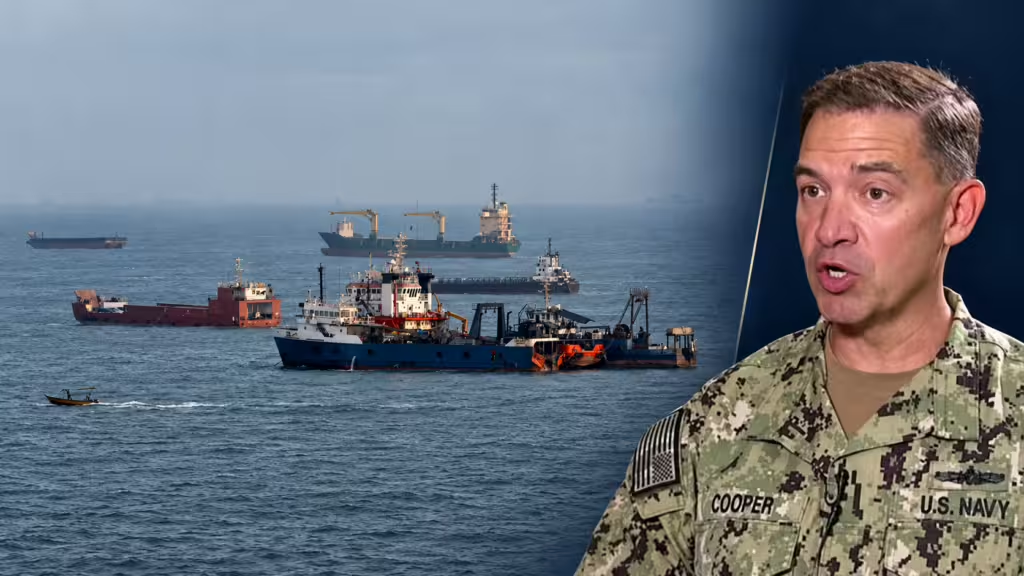
- Adm. Brad Cooper said he flew over the Strait of Hormuz and saw no IRGC presence.
- Cooper said US forces sank Iran's navy earlier this year and cleared Iranian sea mines.
- Trump said Friday the war with Iran will end very soon, repeating his no-nuclear-weapon vow.
The latest:
No Iranian Revolutionary Guard vessels were visible in the Strait of Hormuz during a recent overflight, US Central Command chief Adm. Brad Cooper said in a video released Friday. He said dozens of commercial ships — cargo, crude and LNG carriers — were transiting alongside US aircraft, vessels and a squadron of advanced sea drones on patrol. Cooper attributed the absence to Iran’s navy having been sunk.
Details:
- The claim: Cooper said the IRGC had patrolled the strait and surrounding waters for decades, harassing, threatening and seizing commercial vessels at will, but was not present during his overflight. He said the reason is that Iran’s navy is now at the bottom of the sea, following US strikes he dated to earlier this year.
- The mine clearing: According to Cooper, US forces cleared the strait’s internationally recognized primary transit routes of Iranian sea mines after sinking the Iranian navy. He said American forces remain highly vigilant and present to keep all primary transit routes in the waterway free and clear. He gave no timeline for how long that posture would hold.
- The numbers: Cooper said he visited some of the more than 50,000 US service members supporting operations across the Middle East this week, including the Strait of Hormuz mission. He also said the US reached a milestone of having helped Gulf partners export more than 1.5 billion barrels of crude oil since summer.
- Trump’s position: Trump said Friday in an interview with Kansas City radio station KCMO that Iran cannot have a nuclear weapon and will not have one. He added that one way or another, the war is going to end very soon. He did not set a date or describe what an end would require.
- The rearmament report: The IRGC is using a vast and secret network of military agencies to re-arm with drones, explosives and heavy-duty machinery while circumventing the US naval blockade in the Strait of Hormuz, according to the reporting. The Pentagon is preparing military options for Trump.
- The warnings: Sen. Chris Murphy warned Thursday that a potential US military plan to resume operations against Iran could trigger a devastating escalation and threaten American national security interests. US Ambassador to the UN Michael Waltz warned the same day over Tehran’s nuclear ambitions and its refusal to allow monitoring at nuclear sites.
- The White House line: Vice President JD Vance pushed back against concerns that US involvement in Iran could spiral into a “forever war,” insisting Trump would accomplish America’s military objectives. The administration has not published a scope or duration for the campaign.
- The regional front: Saudi air defense forces shot down two missiles fired toward Riyadh on Thursday by Yemen’s Houthis, a coalition spokesman said. No casualties or damage were described, and the spokesman did not say where the missiles were launched from inside Yemen.
Between the lines:
Two accounts of Iranian capability sit side by side. Cooper describes a naval force eliminated and a waterway cleared; the rearmament reporting describes the IRGC rebuilding through drones and explosives while working around the same blockade. Both can hold at once — sea power destroyed, asymmetric capacity regenerating — which is also why the Pentagon is still drafting options rather than closing the file.
What’s next
Watch whether Tehran readmits nuclear monitors after Waltz’s warning, whether the Pentagon’s options reach Trump’s desk, and whether crude transit volumes through Hormuz hold at the pace Cooper described.