The latest:
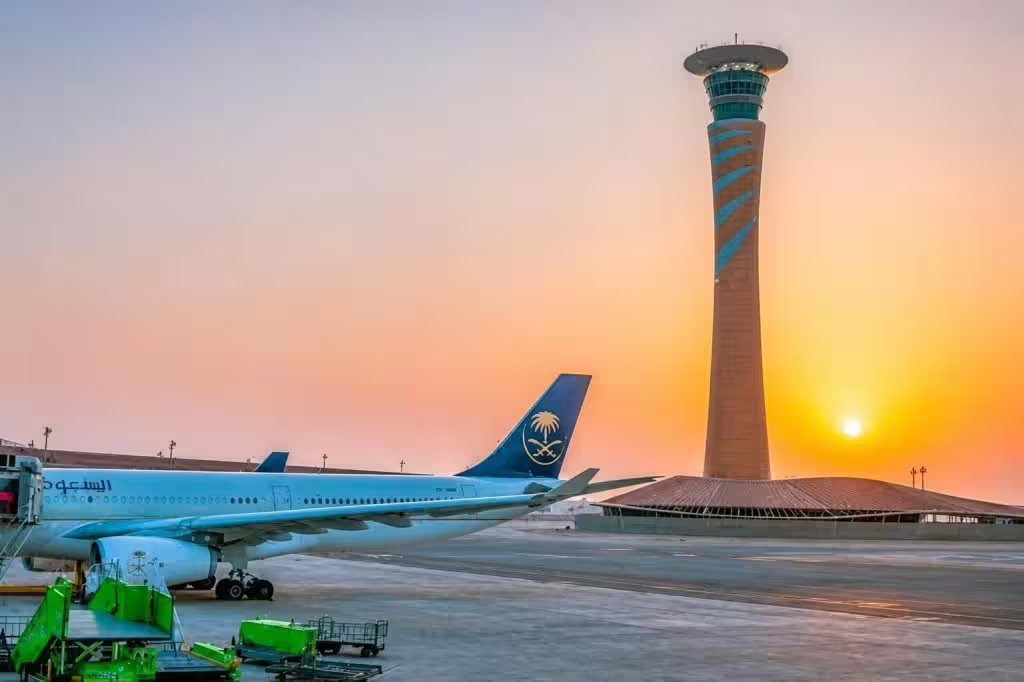
At least 12 people were killed and more than 300 wounded, many critically, when a strike believed to involve a missile or drone hit a passenger terminal at Riyadh’s international airport on Saturday, Saudi authorities said. It was the deadliest attack in the kingdom in more than a decade. Officials suspended operations at the airport, the third Houthi attack there in a week.
Details:
- The toll: Saudi authorities said Saturday’s strike on the passenger terminal killed at least 12 people and wounded more than 300, many of them in critical condition. The weapon is believed to have been a missile or a drone. The authorities did not specify which.
- The pattern: The Iran-backed Houthi militia carried out three deadly attacks on the international airport in the Saudi capital over the past week, according to The New York Times. The cumulative effect forced officials to halt operations at the kingdom’s main aviation gateway.
- The war comes home: The strikes moved a conflict that had been fought on Yemeni soil into Saudi Arabia itself, stripping Saudis and foreign residents of a sense of safety they largely retained through years of the Saudi-led bombing campaign in neighboring Yemen.
- The economic stake: The attacks hit the core of the effort to convert Saudi Arabia from a closed, oil-dependent state into a global business and tourism center. Gregory Gause of the Middle East Institute said an attack on Riyadh’s airport would make anyone weighing investment in the country reconsider.
- No military fix: Analysts told the paper that defeating the Houthis militarily is unlikely to succeed. The group has little left to lose and has accumulated substantial combat experience through repeated confrontations with stronger, wealthier adversaries.
- No political fix: A negotiated settlement has become extremely difficult, analysts said, as the Houthis grow more confident and raise their demands. That leaves Crown Prince Mohammed bin Salman squeezed between an unwinnable campaign and a counterpart with no incentive to concede.
- The American role: Saudi Arabia receives significant US military support against the Houthis, including targeting assistance and aerial refueling. President Trump said he would make a “decision” on intervening more forcefully after Saturday’s airport attack, without elaborating.
- The precedent: Trump launched a bombing campaign against the Houthis last year and declared a swift victory after the United States expended roughly $1 billion worth of weapons and munitions in the first month alone.
- The asymmetry: Gause said damage inflicted on Saudi infrastructure far exceeds what the other side absorbs. He argued the only realistic solution is ending the Iranian-American confrontation so Washington presses Tehran to bind the Houthis to a halt in hostilities under a comprehensive deal.
- Inside the family: Prince Turki al-Faisal, a senior royal and former Saudi intelligence chief, told the Saudi newspaper Arab News last week that while the kingdom has long preferred restraint in its foreign policy, the Houthis have exhausted the leadership’s patience and restraint is no longer workable.
Between the lines:
The pressure described by analysts is commercial as much as military. A suspended capital airport and a terminal struck by a drone undercut the investment pitch that underpins the kingdom’s transformation plan. Gause’s doubt that Trump is listening on the Iran file suggests Riyadh’s preferred exit route runs through a decision it does not control.
What’s next
Watch for Trump’s promised decision on deeper US involvement, the resumption of operations at Riyadh’s airport, and whether Saudi officials shift from restraint toward a declared military or diplomatic response.