Key Points
- Danaher said Wednesday it will launch its first AI-powered autonomous research lab, operating at scale in early 2027.
- The lab combines AI, robotics and tools from several Danaher operating companies into one connected drug-discovery workflow.
- Danaher projects molecule discovery eight times faster and a tenfold annual rise in target-binding molecules generated.
The latest:
An AI-powered autonomous research laboratory built to design, build and test molecules without step-by-step human direction is set to run at scale in early 2027, Danaher said Wednesday. The life sciences company said the facility is intended to make drug discovery and development faster and more efficient. It did not disclose the lab’s location or the size of the investment behind it.
Details:
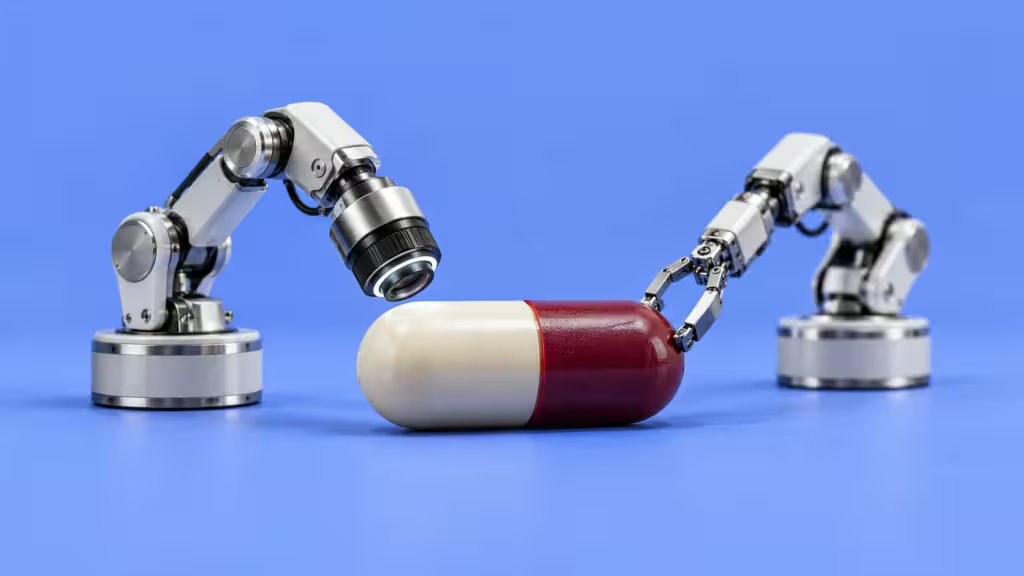
- The setup: According to Danaher, the lab will combine artificial intelligence, robotics and technologies drawn from several of the group’s operating companies inside a single connected workflow. The stated output is custom antibodies and other molecular tools, rather than finished therapeutics.
- The numbers: Danaher expects the lab to make discovering molecules eight times faster and to unlock a tenfold increase in the number of target-binding molecules generated each year. The company did not publish a baseline against which those multiples are measured.
- How it works: The company said the system uses AI to help create new molecules that bind specifically to a biological target, including antibodies. Each candidate is then built and physically tested, and every result is fed back into the model to improve the next round of designs.
- The closed loop: That design-build-test-learn cycle is what Danaher describes as autonomy: the model’s output becomes the next experiment, and the experiment’s data retrains the model. The company did not specify how much human review sits between a generated design and a physical test.
- The company line: JC Gutierrez-Ramos, chief science officer at Danaher, framed the automation as redirecting scientists rather than replacing them, saying it “frees them to focus on the complex scientific challenges where human insight matters most.”
- The wider program: Danaher said the lab is one example of a broader internal effort aimed at building what it called a fleet of smart instruments across the group. The company did not name the other operating companies involved or set out a timeline for the rest of that program.
- The timing: The announcement sets early next year as the launch window, with the lab projected to operate at scale in early 2027. Danaher gave no interim milestones between launch and full-scale operation.
- What’s unstated: Danaher did not say whether the lab will serve internal pipelines, external pharmaceutical customers, or both, and it set out no revenue expectation tied to the facility.
Background:
Danaher sells instruments, reagents and services to pharmaceutical and biotech developers through a group of operating companies, which is why the lab is being assembled from technologies the company already owns rather than built from scratch.
Between the lines:
The claimed gains are framed as throughput, not success rates: eight times faster discovery and ten times more target-binding molecules describe how many candidates the system produces, not how many survive clinical testing. Because Danaher supplies the instruments and reagents behind such workflows, a fleet of smart instruments also points to a product line it could sell, not only an internal capability.
What’s next
Watch for Danaher to name the lab’s location, its operating companies and any customer arrangements, plus any update on launch timing or performance metrics in upcoming quarterly results.