Key Points
- Tesla's Full Self-Driving drove above posted 30 km/h limits during a Reuters test in Brussels
- Footage shows the car's display reading 45 km/h past a repeated-limit sign
- A Belgian road-safety group had already questioned FSD's compliance with local traffic rules
The latest:
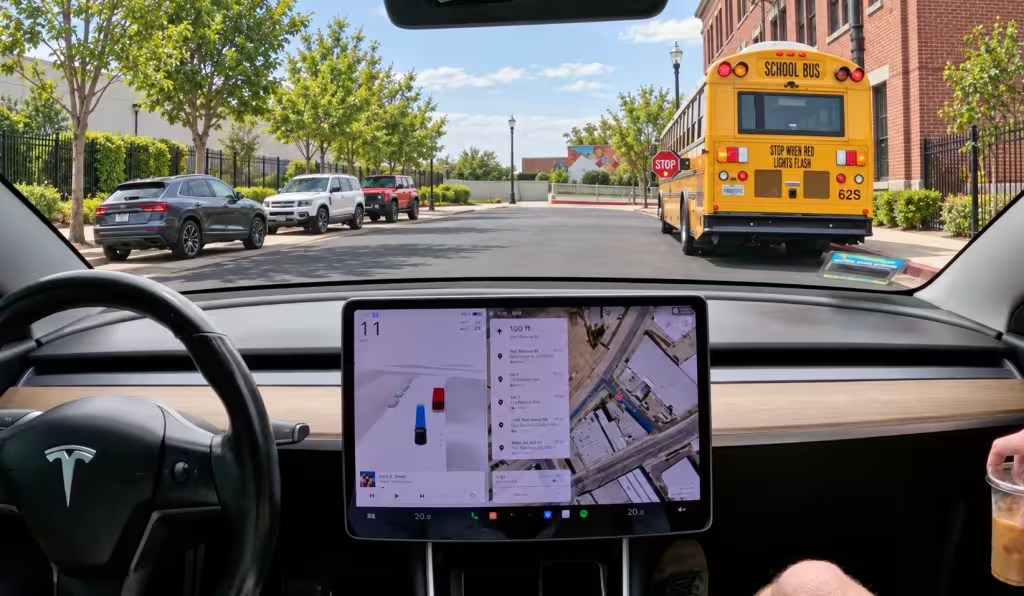
Tesla’s Full Self-Driving system exceeded some 30 km/h speed limits during a Reuters test conducted last week in Brussels, according to Reuters. The test footage shows the vehicle’s onboard display reading 45 km/h as the car passed a posted 30 km/h sign in a residential neighborhood. The result echoes concerns previously raised by a Belgian road-safety group about the technology’s compliance with local traffic rules.
Details:
- The test: Reuters said it ran the trial in Brussels last week using a Tesla operating its Full Self-Driving driver-assistance system, and recorded the vehicle exceeding posted limits on streets signed at 30 km/h. The outlet published footage of the drive alongside its account.
- The numbers: According to Reuters, the car’s display read 45 km/h as it passed a 30 km/h sign — a gap of 15 km/h, or 50% above the posted maximum, on a street carrying one of the lowest urban limits in use across the city.
- The sign: The limit the vehicle passed was marked by a rappel sign, the European repeated-limit marker reminding drivers that a lower restriction already in force still applies. Reuters said its presence sharpens the question of whether the system reliably detects and obeys lower urban limits.
- The safety group: Reuters said the findings echo concerns previously raised by a Belgian road-safety organisation over whether Tesla’s driver-assistance technology consistently follows local traffic rules. Reuters did not name the group or date the warnings it had issued.
- Why Europe is harder: Reuters noted that speed limits across European markets can change street by street, and that digital mapping data does not always match what is posted on the road. That mismatch is central to the compliance question, since a system reading stale map data can set a speed the signage no longer permits.
- What FSD is: Full Self-Driving is marketed by Tesla as a driver-assistance package, not an autonomous system, and it requires the driver to remain attentive and in control. Reuters framed the test around whether the system follows rules, not whether it can replace the driver.
- Scope of the finding: The documented behaviour covers a single test drive in one city, on streets signed at 30 km/h. Reuters reported exceedances on some of those limits rather than a systematic failure measured across routes or markets.
- Tesla’s position: No response from Tesla to the test findings was reported, and the company has not set out publicly how its system reconciles posted signage with mapping data in European cities where limits shift block to block.
Background:
Brussels applied a near-citywide 30 km/h default limit in 2021, making low-speed zones the norm across most of its street network. That makes correct detection of 30 km/h signage a routine requirement for any driver-assistance system operating in the Belgian capital.
Between the lines:
The gap Reuters describes is a rules-compliance problem, not a hazard-detection one. A system reading 45 km/h where a rappel sign posts 30 is applying a speed its data says is legal. That distinction matters for European regulators, because mapping accuracy and signage recognition fall under different oversight than collision avoidance — and a 15 km/h overshoot on a residential street is the margin low-speed zones were created to remove.
What’s next
Watch for a response from Tesla to the test findings, any statement from Belgian road-safety or transport authorities, and whether European regulators request data on how the system reads posted limits.