The latest:
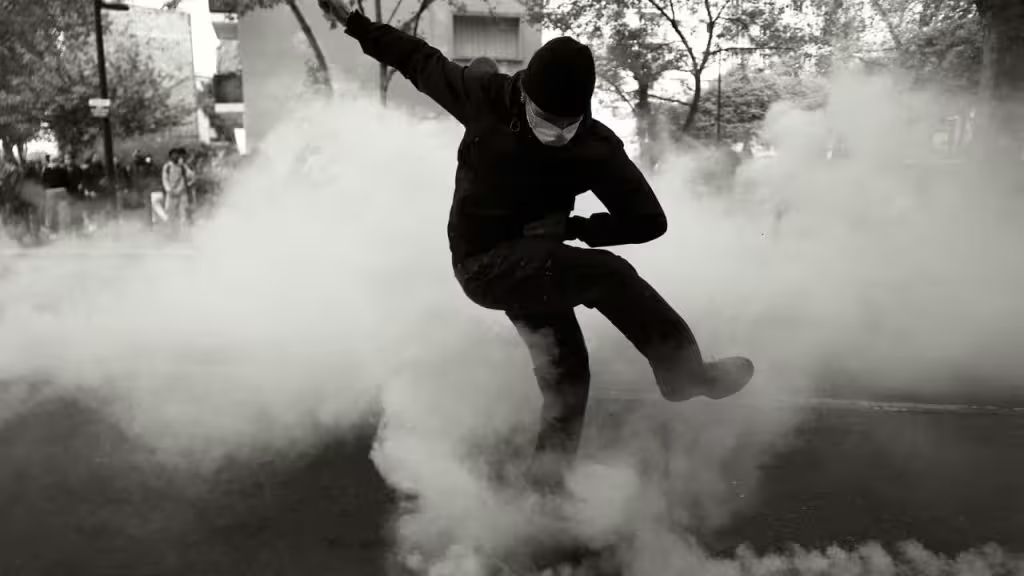
Riot police fired tear gas in Paris and several other French cities on Tuesday as students and supporters demanded more education funding, in demonstrations the Interior Ministry put at 266,000 people nationwide, including 56,000 in the capital. The Education Ministry said roughly 500 people were detained. Prime Minister Sebastien Lecornu told parliament the government and school leaders must listen to students’ concerns.
Details:
- The numbers: The Interior Ministry counted 266,000 demonstrators across France on Tuesday, 56,000 of them in Paris, where small groups clashed with riot officers in a city square at the end of a largely peaceful march, the Associated Press reported. Marches also filled Marseille and Strasbourg.
- The arrests: Police have detained more than 6,500 people since the movement began, most of them minors, according to the Associated Press. Interior Minister Laurent Nunez said more than 5,000 were held last week alone, 85% of them minors. Around 2,000 police and gendarmes were deployed Tuesday.
- The injuries: Agence France-Presse reported 215 students, more than 700 security personnel and about 100 education staff injured since the movement started. A 16-year-old lost sight in one eye during a school blockade in Tours, and a 15-year-old lost a hand Monday after police used a stun grenade in Lens.
- The investigations: The national police inspectorate has opened ten investigations over contested interventions, according to Agence France-Presse. Nunez defended officers, saying the response was proportionate in almost all cases and that protests at times turned into riots requiring intervention. He said 715 officers were injured.
- The government line: Lecornu condemned what he called excessive violence threatening schools, pledged to investigate any incidents and dismissed allegations of police racism as a lie. He accused the radical left of seeking to plunge the country into chaos before April’s first round, telling lawmakers: “Violence is part of your political project.”
- The opposition: France Unbowed leader Jean-Luc Melenchon urged supporters to stand between students and police, accusing officers of brutality. Lawmaker Aurelien Le Coq called the violence intolerable. The party rejects accusations that it fueled the unrest, saying authorities are reducing the movement to its excesses.
- The demands: Protesters say education conditions vary sharply by region, with students in poorer districts getting worse teaching and infrastructure. Complaints center on crumbling buildings, overcrowded classes, staff shortages and unreplaced absent teachers. Students also object to school days that often run from 8 a.m. into the evening.
- The budget: Education is among the largest allocations in the draft 2027 budget, with 65.5 billion euros for schools against 63.4 billion proposed for defense, according to Agence France-Presse. The protests come alongside rising prices and planned cuts to youth benefits including housing aid.
- The spread: The movement started on September 17 in Creteil, southeast of Paris, where teachers and students protested understaffing. Of roughly 3,700 secondary schools nationwide, 589 saw disruption Monday, down from about 800 on Friday, the Education Ministry said. The student union counted 32 university sites blockaded Monday.
- The reactions abroad: US President Donald Trump linked the unrest to what he called mass immigration gone out of control, saying the issue was not about schools. Iran summoned French Ambassador Pierre Cochard on Tuesday, accusing Paris of violent treatment of protesters and gross human rights violations.
Background:
The protests began on September 17 at a school in Creteil over staff shortages and spread through the Paris suburbs to smaller towns nationwide. Macron, nearly a decade in power, cannot run for a third consecutive term.
Between the lines:
The clash is already an election fight. Lecornu casts the unrest as an opposition project ahead of April, while Melenchon has positioned himself physically between students and police. The movement’s 17-year-olds are a constituency both sides are addressing well before they can vote.
What’s next
Student groups have called new protests for Thursday. Macron is set to meet senior ministers on the demonstrations, the government has ordered schools closed through the end of this week, and the CGT union has urged workers to join.