
Key Points
- Tate Modern's Frida Kahlo exhibition runs until January 3, 2027, in London
- Advance sales hit 40,000 tickets, the fastest in the museum's history
- The show examines how Kahlo's self-portraiture was turned into a global commercial icon
The latest:
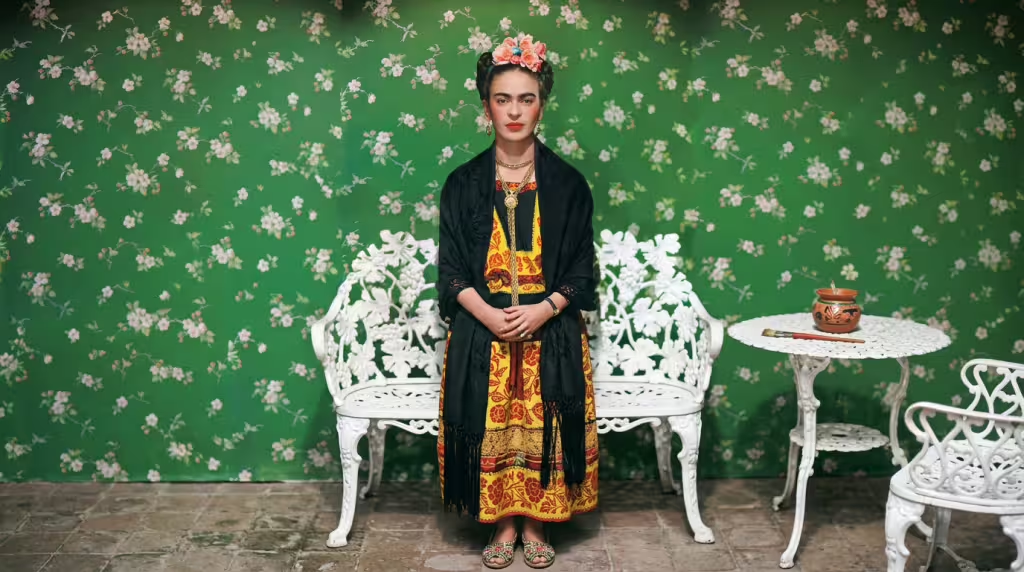
A Frida Kahlo exhibition billed as the making of an icon has opened at Tate Modern with 40,000 tickets sold before opening day, the briskest advance sales in the museum’s history, according to a review in the TLS. The show runs until January 3, 2027, and pairs roughly 30 Kahlo works with more than 100 pieces by artists she inspired.
Details:
- The works on show: The exhibition brings together some 30 paintings and sketches by Kahlo, along with numerous photographs and works by her contemporaries, according to the TLS review. They are shown alongside more than 100 pieces made by later artists who cite her as an influence.
- The curatorial angle: Where the V&A’s 2018 show of Kahlo’s personal effects was subtitled Making her self up, Tate Modern goes further by asking how a self-made artist became an icon, the review says. Its premise is that no icon makes herself: she requires interpreters and a dazzled public.
- The merchandise: The review notes the Tate shop will sell floral headbands and toy parrots alongside a skateboard priced at £220 carrying a detail from Kahlo’s Self Portrait Dedicated to Dr Eloesser — a product the writer calls ironic given that Kahlo became an amputee.
- Why the self-portraits: Kahlo painted herself partly out of necessity, the review says, because she was bed-bound for long periods after operations and worked with a rigged-up canvas and a mirror suspended above her. She typically appears in full body or full face, in a range of guises.
- The Instagram parallel: The reviewer argues Kahlo’s direct address to the viewer speaks to the selfie age, allowing anyone familiar with filters to feel kinship with her without any reference to her politics or her experiences.
- The biography: Born Frieda Kahlo in 1907, she preferred to give her birth year as 1910, the year of the Mexican Revolution, according to the review. She died at 47.
- The medical history: At age seven Kahlo suffered the first of many disabilities when polio withered her right leg and foot. Dr Eloesser suspected she may also have been born with spina bifida, the review says.
- The competing explanations: The reviewer lists the possible sources of Kahlo’s pull: her pain and heroism after a serious accident, her suffering at the hands of her philandering husband Diego Rivera, her socialist politics, or simply her face, framed by fauvist colour, Mexican flora and a legendary unibrow.
- The name recognition: Kahlo’s fame is now such that she is identifiable by her first name alone, the review says, with her image reproduced on notebooks, sponge bags and posters.
Between the lines:
The reviewer’s framing sets up a tension the show itself must carry: the same gaze that made Kahlo legible to a selfie-driven audience is what detaches her from the polio, the surgeries and the politics behind it. The £220 skateboard bearing a detail from a portrait dedicated to her doctor is offered as the sharpest illustration of that gap between the biography and the merchandise built on it.
What’s next
The exhibition runs at Tate Modern until January 3, 2027, with final attendance figures the measure of whether the record advance sales translate into a record-breaking run.