The latest:
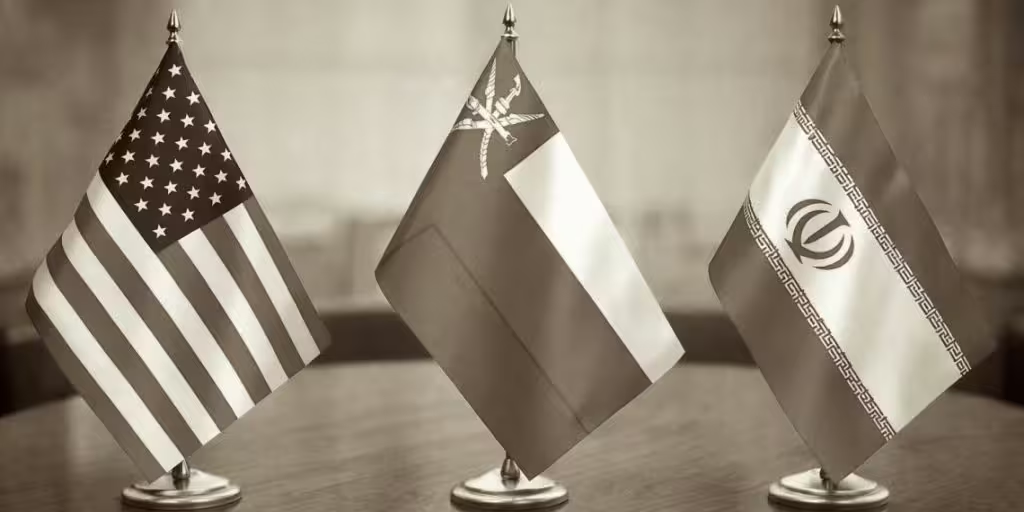
Oman is refusing to abandon its mediation role with Iran after President Donald Trump threatened to bomb the sultanate heavily if it obstructs efforts to reopen the Strait of Hormuz, in remarks to Fox News on August 17. Foreign Minister Badr al-Busaidi wrote in the Financial Times that Muscat will not pull back, while faulting some world leaders for sidelining professional diplomats.
Details:
- The threat: Trump told Fox News the United States would bomb Oman heavily if it stood in the way of reopening the Strait of Hormuz. It was his second such warning; in May he threatened to blow up Oman if it did not behave properly. Omanis interviewed described the language as shocking.
- The contradiction: A preliminary peace framework Trump signed with Tehran less than two months before the threat had assigned Oman the task of conducting a dialogue with Iran over the future of the strait, the narrow waterway between Iran and Oman vital to global oil supplies.
- The collapsed talks: Busaidi mediated three rounds between Washington and Tehran in February. After a Geneva meeting on February 26 he announced major progress, and on February 27 said a peace agreement was within reach. The following day, the United States and Israel began bombing Iran.
- The war: The conflict that started at the end of February has run more than six months without an end. Oman has stayed in the talks throughout, often in parallel with Qatari and Pakistani-led tracks, with most of those contacts kept secret.
- Meeting cancelled: Oman was due to host Gulf foreign ministers, including Iran, on Monday to discuss reopening the strait. The session was called off late Sunday, with Busaidi saying the postponement served the interest of consensus.
- Gulf criticism: Officials in other Gulf states privately fault Oman for not clearly condemning its neighbor while Iran struck regional powers with missiles and drones in response to the American-Israeli attacks. Saudi Arabia was previously irritated by Oman’s secret talks on the 2015 nuclear deal.
- Why Trump turned: Tyler Parker, assistant professor of political science at Mercer University, said Trump grew frustrated because he viewed the 2015 nuclear deal Oman helped broker as tilted against Washington, and has been angered again by a perception that Oman is closer to Iran.
- The toll dispute: Iranian officials said Oman was open to creating a transit fee system for the Strait of Hormuz, a claim Muscat recently denied. A former US diplomat, speaking anonymously, said Omani silence and the delayed denial let Tehran shape the narrative.
- Ties at stake: Bilateral trade runs about 4 billion dollars a year, and Oman is among roughly 20 countries with a comprehensive free trade agreement with the United States, according to the American Chamber of Commerce in Oman. A 500-million-dollar Trump-branded golf resort is due to open in 2028.
- Economic fallout: Tourism has fallen because of the war, but Oman’s position outside the strait brought gains: oil and gas sales boomed and it expanded as a logistics hub, with goods landing at Omani ports then trucked onward. Chamber head Ali Daoud said Kuwait, Qatar and Bahrain saw sharp export declines.
Background:
Sultan Qaboos bin Said built Oman’s reputation as the Switzerland of the Middle East over 50 years, setting a friend to all, enemy to none doctrine. Muscat mediated in the Iran-Iraq war, the Qatar blockade and Yemen’s civil war. Sultan Haitham bin Tariq took power in 2020.
Between the lines:
Oman’s dilemma is structural: the same discretion that made it the channel for three rounds of US-Iran talks now reads in Washington as alignment with Tehran. Its slow public denial of the transit-fee claim, cited by a former US diplomat, shows the cost of that silence. Daoud’s remark that Omanis may need to tell their story louder points the same way.
What’s next
Watch whether the postponed Gulf foreign ministers meeting on reopening the Strait of Hormuz is rescheduled, and whether Oman issues a firmer public rejection of the Iranian transit-fee proposal.