Key Points
- Tehran plans a Hormuz exclusion zone as military attacks and shipping restrictions intensify the confrontation with Washington.
- Iran says it struck an unmanned U.S. vessel; Central Command dismissed the claim as a “total lie.”
- Lebanon casualties and surging oil prices show the widening regional and economic impact of renewed hostilities.
The latest
Iran plans to declare an exclusion zone near the Strait of Hormuz within days or weeks, extending from the line of the U.S. naval blockade toward the strait and into the Persian Gulf, Iranian state media said. Mohsen Rezaei, the new head of Iran’s Supreme National Security Council, said vessels attempting to transit the area would be identified and could be placed on an Iranian sanctions list, adding a new pressure point after roughly a month of relative calm.
Details
- Zone boundaries: Iranian state media said the restricted area would run from the blockade line toward Hormuz and the Persian Gulf. Tehran says vessels crossing it could face identification and blacklisting, although the formal boundaries and enforcement terms await the planned announcement.
- Contested attack: Iran said the Islamic Revolutionary Guard Corps hit an unmanned U.S. military vessel entering waters Tehran considers restricted. Capt. Tim Hawkins, a U.S. Central Command spokesperson, rejected the account as a “total lie.”
- Strike sequence: The U.S. military said American forces struck three Iranian oil tankers on Saturday after Iran launched ballistic missiles at two U.S. Navy warships. American officials said the missiles did not hit either vessel. Parliament Speaker Mohammad Bagher Qalibaf warned that further attacks would draw a “faster, heavier and more painful” response.
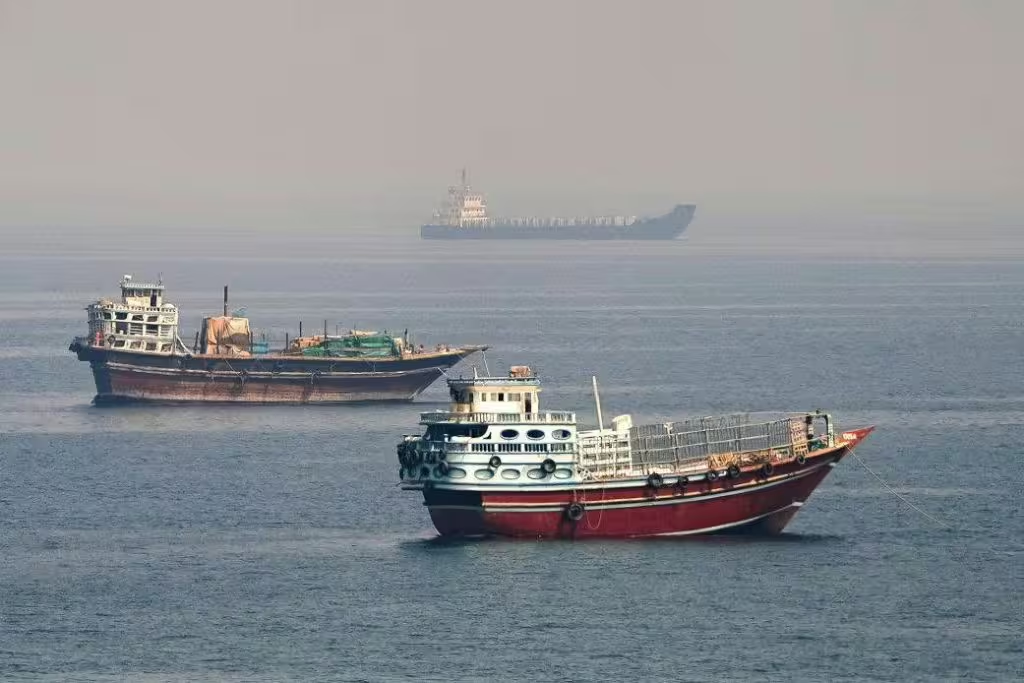
- Shipping pressure: The United States says more than 20 warships are enforcing a blockade intended to restrict Iranian oil exports. American forces have redirected 92 commercial vessels and disabled three. Iran added 11 vessels to its blacklist, raising the total to 56, including crude, LNG, LPG and clean-product carriers.
- Energy markets: More than 9 million barrels of oil normally pass through Hormuz daily, U.S. officials said, while tanker traffic has fallen to its lowest level since May. Brent crude reached about $97 a barrel Monday and West Texas Intermediate traded above $92 as supply concerns intensified.
- Lebanon front: Israeli strikes in southern Lebanon killed at least 11 people and wounded more than 20 on Sunday, Lebanese authorities said, while a vacant hospital was destroyed. Israel said it acted after a Hezbollah drone attack on troops and described the former hospital as a command center. It also targeted weapons storage sites and other Hezbollah infrastructure despite a ceasefire in place for more than two months.
Background
Iran has also created an “Economic War Headquarters” to address sanctions and the U.S. blockade’s impact on oil exports. The steps on both sides have made Hormuz a central arena in the confrontation, while low-level clashes and Israeli strikes continue in southern Lebanon despite the ceasefire.
What’s next
Tehran is expected to publish the exclusion zone within days or weeks. Its boundaries, transit rules and any resulting vessel identifications or blacklist additions will be the immediate indicators of implementation.