Key Points
- The Economist reports the Muslim Brotherhood at its weakest point since the Arab spring, split into two rival leaderships.
- Washington listed the Egyptian and Jordanian branches as global terrorists on January 13th; Jordan banned the group in April 2025.
- The magazine argues repression removes the organisation, not the economic grievances that recruit for it.
The latest:
The Muslim Brotherhood has been reduced to jailed leaders, rival command structures and American terror designations, according to The Economist, which describes the movement as weaker than at any point since 2011. The magazine opens with Ennahda founder Rachid Ghannouchi, 85, who it says passed out in his cell at Tunisia’s Mornaguia prison on July 17th as heat climbed past 50°C.
Details:
- The Tunisian case: The Economist reports Ghannouchi collapsed on July 17th in Mornaguia prison outside Tunis, and says President Qais Saeed is emulating Egypt’s Abdel Fattah al-Sisi by jailing him. The magazine offers no detail on his current medical condition, his legal status, or any official Tunisian response to the incident.
- The US designations: According to the report, Donald Trump instructed his administration in November to designate the Brotherhood’s chapters as terrorists. On January 13th the Egyptian and Jordanian branches were listed as global terrorists for aiding Hamas, while the Lebanese branch was deemed a foreign terrorist organisation. No sanctions consequences are specified.
- The counterterrorism framing: The magazine says a new American counterterrorism strategy issued in May grouped the Brotherhood alongside al-Qaeda and Islamic State as a wellspring of modern jihadism. It adds that it is unclear which faction of the fractured movement Washington is actually targeting.
- The split: Two factions have existed since 2021, when Ibrahim Munir dissolved the movement’s structures in Turkey from exile in London, while secretary-general Mahmoud Hussein claimed Munir had been deposed. Each faction now has its own leader, Shura council and website, and each insists it is the authentic organisation.
- Money and legal defence: Salah Abdel Haq, who took over Munir’s faction after his death in 2022, has promised to challenge the designation in American courts. The report says Hussein’s Istanbul branch rejects the parent body’s authority to answer for anyone, and that Hussein controls the property, Turkish investment companies and cash.
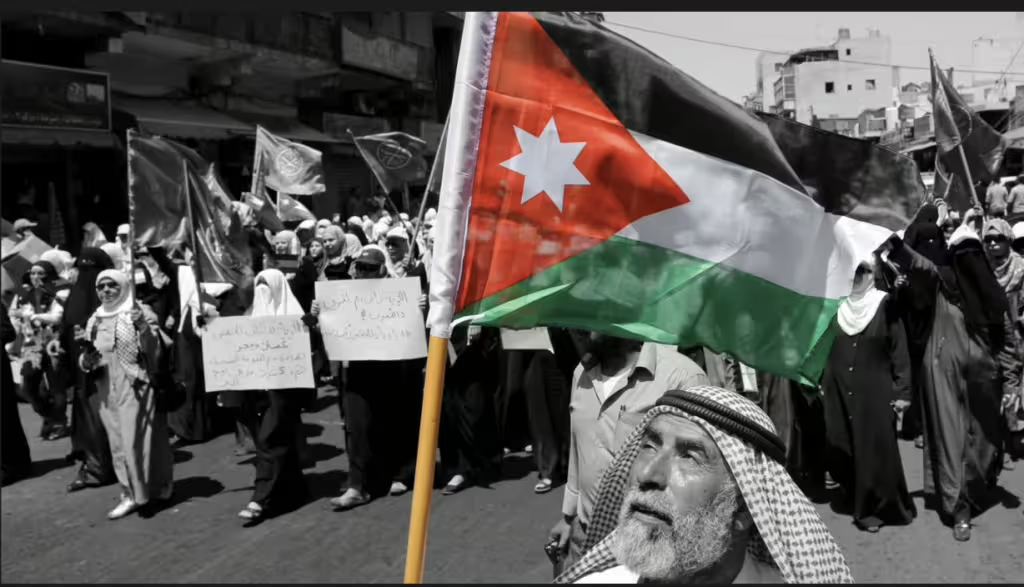
- Jordan’s crackdown: The magazine says Jordan banned the group entirely in April 2025 and has since curbed its political wing, the Islamic Action Front. It does not describe the legal basis for the ban, the number of those affected, or whether the party retains parliamentary representation.
- Egypt: Supreme guide Muhammad Badie is in prison, and the report says Sisi issues holiday pardons but rarely for Brotherhood members, having shut the businesses that once funded its welfare programme. No figures are given for detainees or closed enterprises.
- Gaza and Syria: The report says Israel has devastated Hamas, which grew out of the Brotherhood’s Palestinian branch, with Israeli hit squads pursuing its leaders regionally. In Syria, it says Sunni jihadists rather than the Brotherhood took Damascus in 2024, leaving the group nearly absent from the new parliament.
- Calls to disband: Ahmed Zeidan, an adviser to President Ahmed al-Sharaa with longstanding Brotherhood ties, has suggested the Syrian branch fold itself up, according to the magazine. Writing for Al Jazeera, Syrian analyst Abdulrahman al-Haj argues political Islam is less relevant in the new Syria.
- The survival argument: The Economist notes the group was dissolved in 1948 and crushed by Gamal Abdel Nasser in 1954, and its theorist Sayyid Qutb hanged in 1966, yet its followers won 88 parliamentary seats in Egypt in 2005 and the presidency in 2012. A Western intelligence official told the magazine: “They are just excellent at weathering the storm.”
Background:
Brotherhood-linked parties held Egypt’s presidency and a plurality in Tunisia’s parliament a decade and a half ago, amplified across the Arab world by Qatar’s Al Jazeera. Egypt’s Muhammad Morsi, elected in 2012, died in prison in 2019.
Between the lines:
The Economist’s assessment is that repression erases the structure without erasing its recruitment base: Egypt’s economy leans on IMF support and Gulf deposits, its graduates remain underemployed as in 2010, and Tunisia is no better off than when the Arab spring began there. With Gaza destroyed and Arab governments looking impotent, the magazine argues the movement’s founding claim about spiritual humiliation still resonates.
What’s next
Watch whether Abdel Haq files his promised court challenge to the American designation, further US listings of additional branches, and whether the Syrian branch formally dissolves. The Economist expects the group intact at its centenary in March 2028.